You never know what you’ll find at a flea market … like a 4,000-year-old piece of pottery. That’s what a guy in England discovered, though he didn’t realize what he had until later, after he’d repurposed the jar as a toothbrush holder.
The pottery vessel, adorned with the painting of an antelope, caught the eye of Karl Martin while he was browsing a yard sale five years ago. He picked the jar up, along with another pot, for about $5 (4 pounds).
“I liked it straight away,” Martin said in a statement from Hansons Auctioneers, where he now works and where the pottery was auctioned — selling for about $100 (80 pounds) in November.
The jar dates to the Indus Valley Harappan civilization, which thrived in the northwestern regions of South Asia during the Bronze Age, according to James Brenchley, head of antiquities at Hansons Auctioneers. Read more.
A pair of researchers at Temple University has found evidence that suggests Neanderthals mated and produced offspring with anatomically modern humans multiple times—not just once, as has been suggested by prior research. In their paper published in the journal Nature Ecology and Evolution, Fernando Villanea and Joshua Schraiber describe their genetic analysis of East Asian and European people and how they compared to people from other places. Fabrizio Mafessoni with the Max Planck Institute for Evolutionary Anthropology offers a News and Views piece on the work done by the pair in the same journal issue.
In recent years, scientists have discovered that early humans moving out of Africa encountered Neanderthals living in parts of what is now Europe and Eastern Asia. In comparing Neanderthal DNA with modern humans, researchers have found that there was a least one pairing that led to offspring, which is reflected in the DNA of humans—approximately 2 percent of the DNA in non-African humans today is Neanderthal. In this new effort, the researchers have found evidence that suggests there was more than one such encounter. Read more.
A new study of stone tools from a cave site in China shows that sophisticated “Levallois” tool-making techniques were present in East Asia at a much earlier date than previously thought.
The findings challenge the existing model of the origin and spread of these techniques in East Asia, with implications for theories of the dispersal of modern humans around the world.
The study, by researchers from the University of Wollongong (UOW), University of Washington, Peking University, Chinese Academy of Sciences and China’s Bureau of Cultural Relics Protection, is published online in Nature on 19 November.
Examples of Levallois technology (named after a Paris suburb where tools made with this method were discovered) have been found in Africa and Europe dating back to around 300,000 years ago. Before now, the earliest examples of Levallois techniques in East Asia were dated to 40,000 – 30,000 years ago; the new study places them there as far back as 170,000 years ago. Read more.
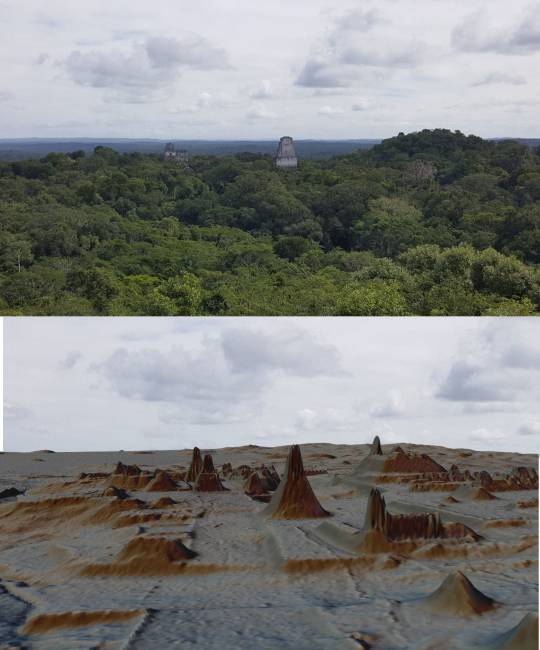
In the autumn of 1929, Anne Morrow Lindbergh and her husband Charles flew across the Yucatán Peninsula. With Charles at the controls, Anne snapped photographs of the jungles just below. She wrote in her journal of Maya structures obscured by large humps of vegetation. A bright stone wall peeked through the leaves, “unspeakably alone and majestic and desolate — the mark of a great civilization gone.“
Nearly a century later, surveyors once again took flight over the ancient Maya empire, and mapped the Guatemala forests with lasers. The 2016 survey, whose first results were published this week in the journal Science, comprises a dozen plots covering 830 square miles, an area larger than the island of Maui. It is the largest such survey of the Maya region, ever.
The study authors describe the results as a revelation. “It’s like putting glasses on when your eyesight is blurry,” said study author Mary Jane Acuña, director of El Tintal Archaeological Project in Guatemala. Read more.
But wait, you’re thinking – Lakshmi is a Hindu goddess, right? She is, the goddess of wealth, fortune and prosperity and the wife of Vishnu.
But this particular Lakshmi figurine was found in the ruins of Pompeii. It is beautiful proof of the trade links between the Roman Empire and the other great civilizations of their day.
The University of Copenhagen in Denmark is home to a unique collection of Ancient Egyptian papyrus manuscripts.
A large part of the collection has not yet been translated, leaving researchers in the dark about what they might contain.
“A large part of the texts are still unpublished. Texts about medicine, botany, astronomy, astrology, and other sciences practiced in Ancient Egypt,” says Egyptologist Kim Ryholt, Head of the Carlsberg Papyrus Collection at the University of Copenhagen, Denmark.
An international team of researchers are now translating the previously unexplored texts, which according to one of the researchers, contain new and exciting insights into Ancient Egypt. Read more.
Six statues dating back 2,000 years were discovered Saturday in the ruins of the ancient Greek city of Magnesia, located in southwestern Aydın province’s Germencik district.
Prof. Orhan Bingöl, who has been overseeing the excavations in the site since 1984, said four female and one male statues were unearthed in the ruins of a temple to Artemis, adding that one of the statues’ gender was unknown.
Bingöl said all statues were found in the same area and were in good condition of preservation, placed face-down next to each other.
“We know that, along with the ones being displayed in Istanbul, Izmir and Aydın, there have been nearly 50 statues unearthed from Magnesia ruins. Read more.
UNSW scientists have shown – for the first time – that a series of high-profile burial sites in the Pacific, Mediterranean and northern Scotland were likely related to catastrophic tsunamis. The work was published in the Journal of Archaeological Method and Theory.
Honorary Professor James Goff from the PANGEA Research Centre at UNSW Sydney, who co-authored the paper, says the research provides new insights into past human-environment interactions and a new perspective on past catastrophic events.
“Tsunamis have never been considered as explanations for burial sites before – which is why no prehistoric coastal mass graves have ever been identified in the archaeological record as tsunami-related.
“Proving that a site is related to a past tsunami could lead to a fundamental rewrite of how we interpret coastal human settlement in prehistory, and change what we thought we knew about the culture and people living in the region at the time. It could also have dramatic implications for how archaeologists analyse a site.” Read more.
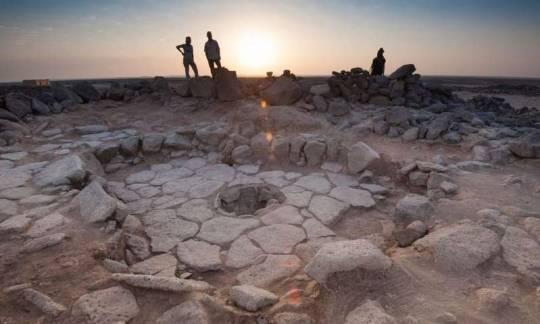
At an archaeological site in northeastern Jordan, researchers have discovered the charred remains of a flatbread baked by hunter-gatherers 14,400 years ago. It is the oldest direct evidence of bread found to date, predating the advent of agriculture by at least 4,000 years. The findings suggest that bread production based on wild cereals may have encouraged hunter-gatherers to cultivate cereals, and thus contributed to the agricultural revolution in the Neolithic period.
A team of researchers from the University of Copenhagen, University College London and University of Cambridge have analysed charred food remains from a 14,400-year-old Natufian hunter-gatherer site—a site known as Shubayqa 1 located in the Black Desert in northeastern Jordan. The results, which are published today in the journal Proceedings of the National Academy of Sciences, provide the earliest empirical evidence for the production of bread:
“The presence of hundreds of charred food remains in the fireplaces from Shubayqa 1 is an exceptional find, and it has given us the chance to characterize 14,000-year-old food practices. Read more.
Archaeologists scanning a Mexican pyramid for damage following September’s devastating earthquake have uncovered traces of an ancient temple.
The temple is nestled inside the Teopanzolco pyramid in Morelos state, 70km (43 miles) south of Mexico City.
It is thought to date back to 1150 and to belong to the Tlahuica culture, one of the Aztec peoples living in central Mexico.
The structure is dedicated to Tláloc, the Aztec rain god.
Archaeologists say it would have measured 6m by 4m (20ft by 13ft). Among the temple’s remains they also found an incense burner and ceramic shards.
The discovery was made when scientists from Mexico’s National Institute of Anthropology and History (INAH) used a radar to check for structural damage to the Teopanzolco pyramid in Cuernavaca. Read more.
This month marks the golden jubilee of a watershed event in the history of this nation that should cause all Australians to pause and reflect.
On July 15, 1968, while searching for clues to past climates and ancient landscapes on land under the joint care of Paakantyi/Barkindji, Ngiyampaa and Mutthi Mutthi people, Earth scientist Jim Bowler ambled across the cremated remains of an Aboriginal woman eroding from a crescent-shaped dune flanking the shoreline of now-dry Lake Mungo in western New South Wales.
The 40,000-year-old “Mungo Lady” and the equally ancient remains of Mungo Man, found nearby in 1974, doubled scientific estimates of how long Aboriginal people had called Australia home.
The discovery taught us Aboriginal history stretched back to a time when the only humans in Europe were Neanderthals, and people had not yet reached America. The scientific, cultural and political reverberations still resonate today. Read more.
In 1923, famed British geologist Herbert Henry Thomas published a seminal study on Stonehenge, claiming to have found the precise spots where prehistoric people had quarried the stones.
There was just one problem with his analysis: It was wrong. And it has taken geologists about 80 years to get it right, a new study finds.
“At best, he [Thomas] was forgetful and sloppy, but at worst he was being deceptive,” said study co-researcher Rob Ixer, a geologist at the University of Leicester and an honorary senior research associate at the Institute of Archaeology at University College London, in England.
In addition to debunking Thomas’ influential work, the researchers announced an additional Stonehenge discovery: Prehistoric people likely didn’t boat the stones though Bristol Channel on the way from where the stones were quarried, in western Wales, to where Stonehenge stands today, in Salisbury Plain. Read more.
A mad rush is needed to preserve or catalogue thousands of Arctic archeological sites before they are washed away by warming hastening the thaw of permafrost and coastal erosion, a study said Thursday.
For millennia, the cold has conserved ivory artifacts, driftwood houses and human remains in often near-perfect conditions.
But with faster and more severe climate change in the poles than the rest of the world, the situation has become desperate, with far more sites that will soon be lost than scientists have the time or resources to document.
“An increasing number of ancient sites and structures around the world are now at risk of being lost,” said the study published Thursday in the research journal Antiquity.
“Once destroyed, these resources are gone forever, with irrevocable loss of human heritage and scientific data.” Read more.








 House of Brat