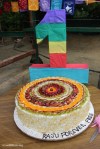
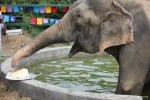
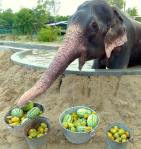
Raju the elephant spent over 50 years in India as a tourist attraction. He was beaten by his handlers, forced to “beg” for money from pedestrians, and was bound by painful chains. Elephants are highly evolved in their emotional intelligence, so this life had detrimental effects on Raju’s mental health. Luckily, Wildlife SOS obtained all the required paperwork and staged a covert rescue of Raju last summer. On July 6th Raju celebrated his 1 year anniversary of his freedom. Look how happy he is today, he even got a cake!!
Perhaps as few as eighty thousand forest elephants remain in the Central African Republic. The story of these declining numbers is also a story of habitat destruction. Where forest elephants exist in an undisturbed state, they build networks of trails through the deep forest. These trails connect mineral deposits, fruit groves, and other essentials of forest-elephant life. In Central Africa, there are dozens of fruit trees whose seeds are too large to pass through the guts of any other animal and for which forest elephants have evolved as the sole dispersers. These trees line the forest-elephant paths. Where elephant populations are disturbed, the paths disappear.
So the traditional royal family order – the one worn by Camilla, Sophie, Diana – is made of ivory. William is an outspoken and active opponent of the illegal ivory trade, and has spent much of his royal life promoting conservation and combatting poachers, the illegal trade, that sort of thing. It was a theory that Catherine hadn’t yet gotten the order from HM because it’s made of ivory, and that would have been a slap in the face to William. Kate’s order is made of glass, which means HM consciously made a few decisions – first, to grant her granddaughter in law this very big honor, and second, to do it in a way that honors her grandson and eventual heir’s wishes. It’s a huge success for William and Catherine. Convincing HM to change anything isn’t easy, but at least one of them convinced HM to do this. It’s a really, really big deal.





 House of Brat