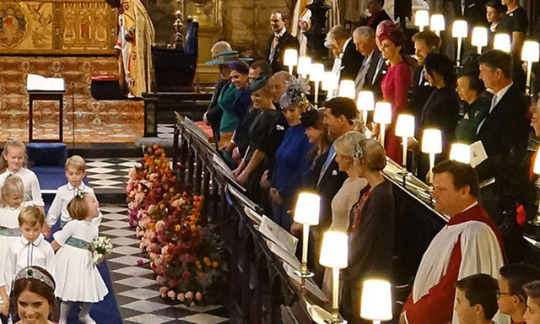
“I was very moved how Princess Eugenie deliberately asked for her wedding dress to show her surgery scar given how much stigma there is around scoliosis and other conditions.“ – Submitted by Anonymous
Nah she’s truly pregnant. In my baby reading I’m doing on them, Fool Reversed came up, meaning making lots of foolish decisions not on purpose. I think that’s what’s happening here.
Yeah. I think she’s truly pregnant. But that doesn’t make watching this train wreck fun.
Particularly now that we know she drank publicly a glass of champagne on a plane while pregnant. How many other times has she drunk champagne since she’s been pregnant? I’m not a beer person, but beer probably would be better to drink since the alcohol content is lower. Beer is usually about 5% alcohol, but champagne is 12% alcohol. Sheesh!
It’s just a supremely boring tour. The clothes are bland neutral crap that doesn’t fit. The settings are meh. The stunts are all stuff they’ve done before with another message piece of clothing like the Husband shirt at Invictus, another girl who looks like Meghan like the actress wannabe at Stemettes, and another baby related medical event just like the one they did in Ireland. Daphne Dunne stands in for Nottingham’s Haribo lady and so on.
I’m legit dying of second hand embarrassment now. “Shop our Royal collection and be the ROYAL that YOU are.” Jess issuing to put out a “royal” collection too, isn’t she? Probably “Duchess” short shorts and official princess lip fillers.
‘The Duke of York told a wonderful joke in his speech,’ a guest said. ‘He recalled that his dog Jack was sitting on a chair and he shouted, ‘Jack, get off!’
‘The dog didn’t move, he said, but Jack Brooksbank shot up and fled.’
One of the things I hate the most about these two is that ALL of their events are 100% biographical. They are supposed to be highlighting the countries and charities they visit, but, instead, it’s all MEMEMEMEME. The focus is on how Harry’s fans worship him, or how Meghan inspires biracial girls, or her cooking skills, or her relationship with her mother, or her American background, or whatever. It’s ALL bout THEM.
I’m no Mary fan, but she dresses a lot better than Meghan and carries herself professionally. She rubs me the wrong away (I find her arrogant and cold), but I have to admit that she looks and acts like a princess and future queen. I cannot even picture Mary wearing a friend’s “royal collection” oversize jacket (”be the ROYAL you can BE”), or showing up somewhere with ginger-chocolate-chip-and-banana bread.
Meghan is a frustrated lifestyle blogger who found a lonely prince and decided that this was her ticket to a life full of published cookbooks, merching, and domestic goddess profiles. She’s trying to use the brf’s platform to create a royal version Goop or something like that. It’s bizarre.
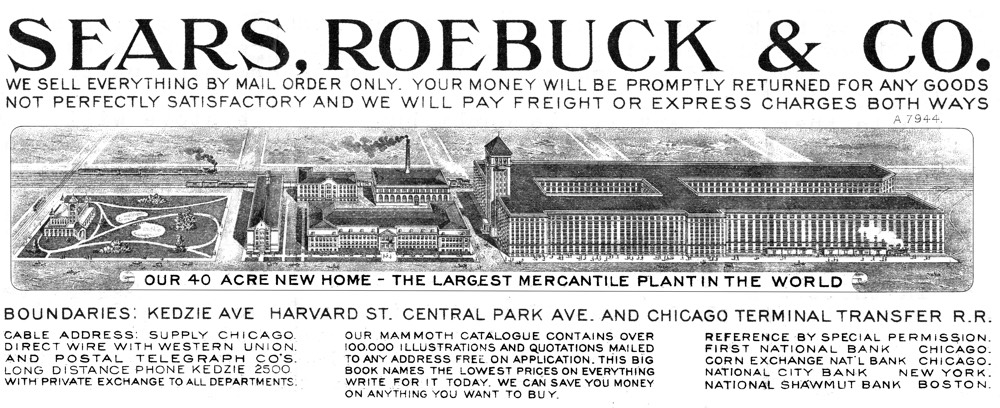
Sears has filed for bankruptcy protection and plans to close hundreds of stores in an effort to keep the company afloat. The Sears catalog is perhaps one of the most important and under-appreciated innovations in American life. Starting in 1888 with a mailer advertising watches and jewelry, Sears introduced millions of Americans to in-home shopping by using the growing networks of the railroad and US Postal Service, much like Amazon and other retailers would using the internet decades later.
The time was right for mail order merchandise. Fueled by the Homestead Act of 1862, America’s westward expansion followed the growth of the railroads. The postal system aided the mail order business by permitting the classification of mail order publications as aids in the dissemination of knowledge entitling these catalogs the postage rate of one cent per pound. The advent of Rural Free Delivery in 1896 also made distribution of the catalog economical.
Every time a black southerner went to the local store they were confronted with forced deference to white customers who would be served first. The stores were not self-service, so the black customers would have to wait. And then would have to ask the proprietor to give them goods (often on credit because…sharecropping). The landlord often owned the store. In every way shopping reinforced hierarchy. Until Sears.
The catalog undid the power of the storekeeper, and by extension the landlord. Black families could buy without asking permission. Without waiting. Without being watched. With national (cheap) prices!
This excellent piece by Antonia Noori Farzan has more info. Reading this, I couldn’t help but think of blind auditions, the practice of auditioning orchestra musicians behind a screen to help cut down on gender bias during the hiring process. While not entirely free of bias – opportunities for discrimination by postal workers and Sears employees were still possible – the Sears ordering process was essentially a blind retail transaction, a screen placed between the store and black customers. (The catalog also advertised racist costumes so obviously Sears wasn’t some bastion of social progressivism…they simply wanted to sell more goods to more kinds of people.)
One of Hancock’s discoveries was Sears’ response to the needs of a rural South in which literacy was rare. For someone who could neither read nor write, placing orders and following written protocols were problematic. Richard Sears responded with a policy that his company would fill any order it received, no matter what the medium or format. So, country folks who were once too daunted to send requests to other purveyors could write in on a scrap of paper, asking humbly for a pair of overalls, size large. And even if it was written in broken English or nearly illegible, the overalls would be shipped.
With Sears declaring bankruptcy, it’s worth remembering how much impact this company had on American music. In my research into blues and other traditional styles, I found that many, many musicians started out on Sears instruments.
Even under Jim Crow, music was an avenue for upward mobility for African Americans, and Sears and other mail-order retailers were more than happy to provide them with instruments.
The United States, circa 2018, looks like a place run by people who know they’re going to die soon.
As “once in a lifetime” storms crash over our coasts five times a year – and the White House’s own climate research suggests that human civilization is on pace to perish before Barron Trump – our government is subsidizing carbon emissions like there’s no tomorrow. Meanwhile, America’s infrastructure is already “below standard,” and set to further deteriorate, absent hundreds of billions of dollars in new investment. Many of our public schools can’t afford to stock their classrooms with basic supplies, pay their teachers a living wage, or keep their doors open five days a week. Child-care costs are skyrocketing, the birth rate is plunging, and the baby boomers, retiring. And, amid it all, our congressional representatives recently decided that the best thing they could possibly do with $1.5 trillion of borrowed money was to give large tax breaks to people like themselves.
See also Dear Young People: Don’t Vote. As Levitz says though, one of the reasons that young people don’t vote is that it’s often more difficult than for older people. Making it easier for everyone to vote would alleviate many of these concerns and result in higher turnout, more political engagement, and better representation for young Americans.
Millennials in the U.S. are more underrepresented than their peers in most other developed countries. Primary responsibility for this fact lies with our nation’s political parties, which have made America an exceptionally difficult place to cast a ballot. If Democrats wish to increase turnout among the young, they’d be well advised to implement automatic voter registration, a new Voting Rights Act, and a federal holiday on the first Tuesday in November, when and if they have the power to do so.
Voter suppression is often, correctly, viewed through a racial or class-based lens – however, these same laws also target younger people. A group that tends to vote more often for third-party and Democratic candidates.
For example, states such as Texas and Ohio require voter identification at the polling place – a college or university ID doesn’t qualify. In Wisconsin, voter ID laws permitted college IDs but not out-of-state drivers licenses, which, local news reported, resulted in many university students getting turned away in the April 2016 primary. In North Carolina, another key state in the Electoral College, hundreds of students cast provisional ballots in 2016, unsure whether their vote would even count because of their strict voter ID laws – which were struck down this year by the Supreme Court, but not before disenfranchising potentially thousands of American citizens.
The Ireland drinking may have been before she found out, but the Canada trip was in August (and Jess told BS Weekly that Meghan told her then) and the Soho House party was in September.
That’s FOUR sightings in a couple of months, which is pretty credible to me. I don’t understand why people are so surprised that someone who is shrugging off Zika virus risk and over scheduling herself during a high-risk pregnancy is also pretty laissez faire about drinking.
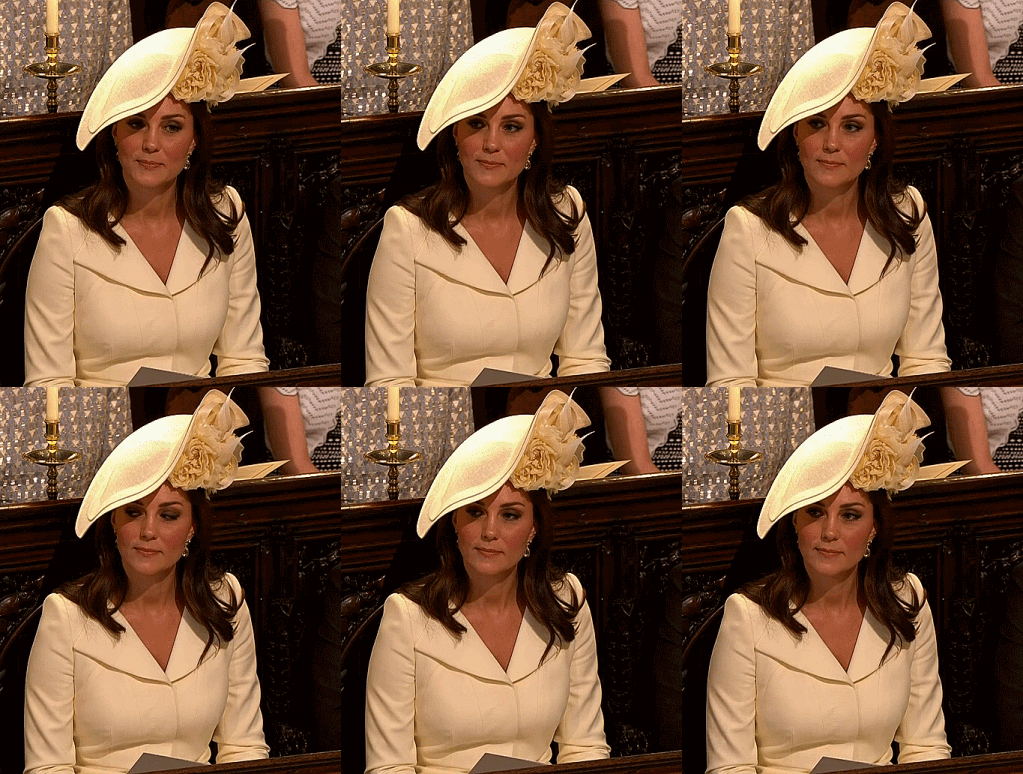
And she had the coat made weeks in advance! That’s the funniest part of it for me. She was picking clothes out in August and decided she would wear a fug couture tent to Eugenie’s wedding to stoke the rumors. She’s amazing.
I thought he sounded very robotic, and the “upcoming baby” part was just weird. “No better place to announce the upcoming baby…”?????? It sounded like he was talking about a Hollywood movie or something.
“A” baby…”the” upcoming baby…the language they are using is oddly neutral.
When she was 16, she moved with her parents from Vermont to Florida to attend a performing arts high school. Soon after she tried OxyContin for the first time at a high school party, and so began a relationship with opiates that would dominate the rest of her life.
It is impossible to capture a person in an obituary, and especially someone whose adult life was largely defined by drug addiction. To some, Maddie was just a junkie – when they saw her addiction, they stopped seeing her. And what a loss for them. Because Maddie was hilarious, and warm, and fearless, and resilient. She could and would talk to anyone, and when you were in her company you wanted to stay. In a system that seems to have hardened itself against addicts and is failing them every day, she befriended and delighted cops, social workers, public defenders and doctors, who advocated for and believed in her ‘til the end. She was adored as a daughter, sister, niece, cousin, friend and mother, and being loved by Madelyn was a constantly astonishing gift.
This is powerfully straightforward writing by Linsenmeir’s family…my condolences are with them. They devoted a few paragraphs at the end of her obit to address addiction and its place in our society:
If you are reading this with judgment, educate yourself about this disease, because that is what it is. It is not a choice or a weakness. And chances are very good that someone you know is struggling with it, and that person needs and deserves your empathy and support.
If you work in one of the many institutions through which addicts often pass – rehabs, hospitals, jails, courts – and treat them with the compassion and respect they deserve, thank you. If instead you see a junkie or thief or liar in front of you rather than a human being in need of help, consider a new profession.
When author and illustrator Jarrett J. Krosoczka was in the fourth grade, his grandparents called him into the living room. “I remember thinking: Oh maybe we’re going to go on another family vacation,” he says. (The last time they called a family meeting he learned they were going to Disney World.)
But this wasn’t that kind of family meeting. Krosoczka’s grandparents had insisted on taking legal custody of him as a toddler — and they were about to tell him why.
“My grandfather sat me down on the couch,” Krosoczka recalls. “And he said: ‘It’s time we tell you the truth about your mother. She’s in jail and she’s a drug addict and that’s why she’s been gone all this time.’ ”
Krosoczka had seen his mother only sporadically since age 2. He had never met his father.
Throughout his childhood, Krosoczka kept this painful information hidden. “I didn’t tell anybody for the longest time …” he says. “When you have these addictions in your families, you sort of live this duality. You have this thing that you hold back from people and you put your best face forward.”
Krosoczka wasn’t an athletic or social kid. Drawing was his refuge, his way of making friends, and his way of dealing with life. “Maybe that’s [where] my storytelling skills began,” he says. “By my making up excuses for where my biological parents were.”
As an adult, Krosoczka became a graphic novelist — publishing books for young readers such as the “Lunch Lady” and the “Platypus Police Squad” series. He considered writing about his own life, but worried his story was too dark.
It wasn’t until he began meeting young fans with similar life stories that he changed his mind. Krosoczka’s new book Hey, Kiddo, tells the story of his mother’s addiction and incarceration from the point of view of his 17-year-old self.
“It took a long time for me to gain that courage to make this book …” he says. “I feel like I owe it to these readers to put myself out there.”
Paul foresaw that computers would change the world. Even in high school, before any of us knew what a personal computer was, he was predicting that computer chips would get super-powerful and would eventually give rise to a whole new industry. That insight of his was the cornerstone of everything we did together.
In fact, Microsoft would never have happened without Paul. In December 1974, he and I were both living in the Boston area – he was working, and I was going to college. One day he came and got me, insisting that I rush over to a nearby newsstand with him. When we arrived, he showed me the cover of the January issue of Popular Electronics. It featured a new computer called the Altair 8800, which ran on a powerful new chip. Paul looked at me and said: “This is happening without us!” That moment marked the end of my college career and the beginning of our new company, Microsoft. It happened because of Paul.
Gates also noted Allen’s love of music. In an interview earlier this year, legendary producer Quincy Jones said Allen “sings and plays just like Hendrix”.
Yeah, man. I went on a trip on his yacht, and he had David Crosby, Joe Walsh, Sean Lennon – all those crazy motherfuckers. Then on the last two days, Stevie Wonder came on with his band and made Paul come up and play with him – he’s good, man.
“Word that three powerful Hollywood Executives had come to see Ashman rippled through the ward. Ashman laid in bed, blind and frail. Geffen knelt by the bed and held Ashman’s hand. ‘You’re going to recover,’ he said. ‘This is going to be cured. A miracle will happen. You bave to believe, just as you have inspired so many to believe in magical things. You must never give up. And I want you to know that you are surrounded by people that love you. They couldn’t be sure that Ashman could hear or understood the words, but his eyes filled with tears. A week later, Ashman died. He never saw the finished print of Beauty and the Beast.”
– James B. Stewart, Disney War, on composer Howard Ashman’s death by AIDS. Ashman composed, with Alan Menken, the music for The Little Mermaid, Beauty and the Beast, and Aladdin.
I’ve heard of those, but I don’t think Megs cares all that much for the legalities. She can get it done outside the UK and Harry’s pretty far down the line of succession.
That being said, I’m in the minority about the surrogacy. The Talking Tarot blog, for example, is pretty sure it’s not surrogacy.
I’ll say it again. Surrogacy contracts are NOT legally enforceable in the UK.
And the kid needs to be born in the UK as part of the royal family.
I’ve been kind of wondering all day when exactly was it that he found out Megs was pregnant, for certain. Given the timeline, he was in Africa for most of August. They partied it up on a weekend in Amsterdam. He looked super nervous inside the chapel at Eugenie’s wedding. Has he really known about it as long as she has?
Or is he just headed for a meltdown by the end of this tour?
Obviously not. I am, however, kind of awed by her ambition, daring, and immense self-centeredness. She met this guy, saw her chance, quit her job immediately, was engaged in like a year, spent millions of dollars of his dad’s money, was married a few months later, and is now pregnant and raiding his mom’s jewelry box. It’s truly amazing.









 House of Brat