By most conventional pundit metrics, Bernie Sanders should be the presumptive 2020 Democratic presidential nominee. To state the obvious, he was last cycle’s runner-up, having won 46 percent of elected delegates, 23 states, and smashed small-dollar fundraising records. His policy platform has taken hold across the party, with most every nationally ambitious figure now calling for universal Medicare, free public college tuition, and a host of other measures that were closely associated with his 2016 run. He has consistently polled as the most popular politician in America, he just won re-election in his home-state by a massive margin, and his social media engagement is off-the-charts. So what’s the problem?
Simply put, large sections of the party still view him as a threat. As much as they’ve attempted to court him, flatter him, and accommodate him in various respects – recall the awkward ‘unity tour’ he held with DNC chairman Tom Perez in 2017 – he is still fundamentally at odds with the interests of the party’s most powerful actors. They might adopt bits and pieces of his agenda, as everyone from New York governor Andrew Cuomo to Nevada senator-elect Jacky Rosen has to varying degrees. And they might offer him polite compliments on the campaign trail, knowing he has an enthused core of supporters. But they will not formally back him in a primary, under virtually any conceivable circumstances. And that’s because for all the kind words Democratic officials have sent his way in the past two years, they are largely just that: words. These entreaties should be seen as attempts at appeasement more than any wholesale endorsement of his basic political program.
Sanders’s economic vision, elementally, is not compatible with the Cuomos and Rosens of the party. He is a socialist, and they are avowedly not. All other considerations around his candidacy can be distilled into that basic, unalterable fact. And this fact is what animates the emerging punditocracy perception of his 2020 prospects. You could almost imagine an alternate universe in which there were demands for the ‘field to be cleared’ for Sanders by virtue of the stature he acquired from the previous cycle. But that’s not happening, and won’t happen, because the ideological chasm he harnessed in 2016 is still there. And it will only continue to widen.
Assumptions about presidential ‘front-runners’ in the political press often derive from the attitudes of party donors, who share their candidate-fancying whims with reporters. This then congeals into a narrative about ‘who’s up and who’s down.’ But Sanders will never be ‘up’ by such a metric, because not only does he have zero interest in supplicating to the party’s donor base – he is actively hostile to them. They were not who he relied on for financial support in 2016, because he pioneered ground-breaking grassroots fundraising tactics which vaulted him to contender status. Central to his overall political vision is doing everything possible to circumvent wealthy donors and diminish their influence.
And these donors are who will continue to shape perceptions of the emerging field among the press. For instance, the FiveThirtyEight politics podcast crew, asked in mid-November to proffer their odds for various Democratic candidates, did not mention Sanders until the third round of their friendly presidential ‘draft’ – almost as if he were a mildly bothersome afterthought. This might be a slightly trivial indicator, but it’s still a reflection of how pundit consensus is overlooking Sanders for a host of reasons – none of which have much to do with empirical reality. In the unreliable yet still extant early polling of the 2020 cycle, Sanders is bouncing around the top, usually just below Joe Biden. But one of the FiveThirtyEight prognosticators picked New York senator Kirsten Gillibrand ahead of him: someone who has done virtually nothing to suggest she has anything close to a formidable national constituency. Sanders, on the other hand, doesn’t have to prove anything in this area: he’s already done it. And yet a slew of new pundit criteria are being formulated to preemptively exclude Sanders, because again, by most conventional metrics he should be deemed the ‘front-runner’ (an admittedly nebulous term). So journalists of various stripes, who have long been instinctively dismissive of him, see no option but to invent brand new metrics.
Dave Wasserman, a Cook Political Report elections data analyst (and typically a very good one), promulgated his conclusion that the ideal opponent for Trump in 2020 must be a young and charismatic female with ‘a natsec background’ and no long history in elected office. Notice that none of these criteria have much to do with policy; it’s on identity grounds that Sanders will probably be most vehemently attacked. He’s too old, white, crotchety, or whatever. But as loud as these criticisms will be, they’ll be underlain by one which is more salient for the power base of the party: the ideological fissure he inescapably represents. People who are most threatened by that might opt for the more superficial arguments against him, because they know Sanders’s socialist vision is increasingly popular with the electorate. But the most central reason for their hostility will always be ideological.
There is another important factor militating against Sanders, at least in the eyes of the opinion-making class. In the 2016 primaries Sanders consistently over-performed with rural white voters, notably in Wisconsin and Michigan, states now crucial to any Democratic victory in 2020. On paper you’d think this would be a huge point in Sanders’s favor, as Democratic losses among that demographic have hobbled their electoral fortunes time after time. But when filtered through the myopic lens of the punditocracy, what might otherwise be regarded as a valuable asset will instead be cast in dark, nefarious terms: as if Sanders’s appeal among these voters makes him vaguely suspicious and perhaps even racist (yes, this will be alleged.)
The 2018 midterms demonstrated that the Democratic party is increasingly anchoring its political support in areas of the country that are highly wealthy, a trend ably described by Matt Karp in Jacobin magazine. He cites Virginia’s 10th congressional district, the richest in the country by median household income, as a case study. This district was one of the night’s most rousing victories for Democrats, with incumbent GOP representative Barbara Comstock dumped decisively for generic Democrat Jennifer Wexton. One could infer, plausibly, that Democrats’ Trump-era messaging has resonated strongest in the country’s most affluent regions – probably due to a combination of cultural aversion to the modern GOP and marginal gripes with the 2017 tax cut bill, which crushed well-off conservative areas in Democratic-leaning states. Now more than at any point in its centuries-old history, Karp declares, Democrats are the ‘party of the prosperous.’
Per the terms of conventional pundit thinking, this bodes ill for Sanders. Sanders has a clear constituency, and it’s emphatically not ‘the prosperous.’ In the 2016 cycle, he frequently trounced Clinton in poor, rural areas, as his landslide victory in the West Virginia primary highlighted. Nationally, the counties in which Sanders performed the best tended to be its most rural and poorest, by median household income. Take California, where he won the five poorest counties by double digits. Conversely, he was battered in the wealthiest counties, where the nucleus of the state’s political power resides – losing rich liberal enclaves like San Francisco, Marin, and San Mateo by huge margins to Clinton.
The rural areas integral to Sanders’s 2016 success are increasingly being written off by Democratic pundits and operatives as unnecessary to forge any winning national electoral coalition. Paul Krugman recently dismissed them as almost intrinsically incorrigible, echoing Clinton’s ‘deplorables’ remark in slightly more charitable terms. And there is some logic to this, however misplaced: Democrats’ biggest gains in the House were disproportionately the very kinds of districts at which Clinton aimed her focus in the 2016 general election – affluent suburbs with tiny shares of persuadable Republicans – to predictably disastrous effect. But now that this narrow approach has yielded geographically-isolated victories in the House, Democrats may reason that Clinton’s strategy wasn’t so bad after all. Consequently, Sanders’s strength among dispossessed rural voters will be argued away, somehow, as a weakness.
With the (hellishly long) 2020 cycle having semi-officially begun, the move will be to pressure Sanders to put aside his ego and bow out for various unpersuasive reasons. Among other tactics, this will take the form of anonymous operatives counseling that he expend his considerable energies on something other than a presidential campaign – the same kind of condescending head-patting that was common in the liberal commentariat during the 2016 run. The logic then was that Sanders should be politely complimented for ‘changing the debate’ in numerous vague respects, but actually supporting his electoral victory was a non-starter. One of the ‘hacked’ emails released by WikiLeaks in 2016 showed Democratic National Committee officials discussing ways to ‘throw [Sanders] a bone’ with meaningless concessions to gain his support, and that attitude will persist as they figure out ways to not-so-gently nudge him from 2020 consideration.
This is all the more ironic, because from a purely electoral standpoint, Sanders stands the best chance against Trump. For one, he is largely unsusceptible to charges of personal hypocrisy – at least by national politicians’ standards – having said much the same thing in public life for several decades. He is not marred by questions around personal corruption, although the FBI investigation into his wife’s land deal in Burlington would have to be affirmatively dealt with at some point. If that’s his one major liability, though, then his liabilities are few – especially compared to the previous Democratic nominee and Trump, whose various personal corruptions could be barely captured by several days’ worth of exhaustive documentation. The age issue will be exhaustively whinged about, but he’s only four years older than the incumbent president, and by all appearances in much better physical shape.
But as much as Democratic power brokers loathe Trump, they can’t countenance Sanders. And their mindset will inform pundit consensus as the hellishly long presidential cycle barrels forward. In Sanders’s calculation, maybe this is for the better. An unambiguous ‘front-runner’ designation would be a mixed blessing, because one of Sanders’s strengths last cycle was how his appeal grew somewhat under the radar, until the evidence for it became impossible to ignore. So it could easily creep up on them again, only this time louder and more determined, backed up by a national infrastructure that didn’t exist in 2016. He also has what amounts to his own sub-rosa alternative media eco-system, which has only grown in the past few years, and some Sanders supporters do now occupy prominent positions in elite journalism, whereas last time there were almost none. So the campaign to disqualify him won’t be easy, but it will be waged vigorously. And that might be exactly what Sanders should want.
Sorry to deliver the news, but it’s time to worry about the next crash.
The combination of stagnant wages with most economic gains going to the top is once again endangering the economy.
Most Americans are still living in the shadow of the Great Recession that started in December 2007 and officially ended in June 2009. More have jobs, to be sure. But they haven’t seen any rise in their wages, adjusted for inflation.
Many are worse off due to the escalating costs of housing, healthcare, and education. And the value of whatever assets they own is less than in 2007.Which suggests we’re careening toward the same sort of crash we had then, and possibly as bad as 1929.
Clear away the financial rubble from those two former crashes and you’d see they both followed upon widening imbalances between the capacity of most people to buy, and what they as workers could produce. Each of these imbalances finally tipped the economy over.
The same imbalance has been growing again. The richest 1 percent of Americans now takes home about 20 percent of total income, and owns over 40 percent of the nation’s wealth.
These are close to the peaks of 1928 and 2007.
The underlying problem isn’t that Americans have been living beyond their means. It’s that their means haven’t been keeping up with the growing economy. Most gains have gone to the top.
But the rich only spend a small fraction of what they earn. The economy depends on the spending of middle and working class families.
By the first quarter of this year, household debt was at an all-time high of $13.2 trillion. Almost 80 percent of Americans are now living paycheck to paycheck.
It was similar in the years leading up to the crash of 2007. Between 1983 and 2007, household debt soared while most economic gains went to the top. If the majority of households had taken home a larger share, they wouldn’t have needed to go so deeply into debt.
Similarly, between 1913 and 1928, the ratio of personal debt to the total national economy nearly doubled. After the 1929 crash, the government invented new ways to boost wages – Social Security, unemployment insurance, overtime pay, a minimum wage, the requirement that employers bargain with labor unions, and, finally, a full-employment program called World War II.
After the 2007 crash, the government bailed out the banks and pumped enough money into the economy to contain the slide. But apart from the Affordable Care Act, nothing was done to address the underlying problem of stagnant wages.
Trump and his Republican enablers are now reversing regulations put in place to stop Wall Street’s excessively risky lending.
But Trump’s real contributions to the next crash are his sabotage of the Affordable Care Act, rollback of overtime pay, burdens on labor organizing, tax reductions for corporations and the wealthy but not for most workers, cuts in programs for the poor, and proposed cuts in Medicare and Medicaid – all of which put more stress on the paychecks of most Americans.
Ten years after the start of the Great Recession, it’s important to understand that the real root of the collapse wasn’t a banking crisis. It was the growing imbalance between consumer spending and total output – brought on by stagnant wages and widening inequality.
HBO guest host Brittany Packnett warned white Republican women that they will not be protected from male oppression just because of the color of their skin.
Packnett, an activist for Teach for America, made the remarks during HBO’s weekly Pod Save American program.
“Let’s talk about our sister Stormy Daniels because she absolutely does not deserve the way that this president has been talking about her,” Packnett said. “But here’s what, frankly, worries me. This ‘president’ – yeah, I used air quotes – he has been talking horribly about women since he was a candidate.”
“He admitted to being a sexual assaulter when he was a candidate and 53 percent of white women went ahead and elected him anyway,” she lamented. “So let me talk to my white sisters for a second. I just want to issue a warning and I hope you are listening closely.”
Packnett continued: “I want you tell your mamas and your aunties and your grandmothers – from me – to stop selling us out! Listen, I know it’s really hard but your whiteness will actually not save you from what patriarchy has for you.”
According to Packett, women should learn from the way Dr. Christine Blasey Ford was treated when she testified against then-Supreme Court nominee Brett Kavanaugh.
“Right?” Packett pointed out. “We all know what happened to her when she decided to stand up and be a patriot in this country and try to save the rest of us.”
Sinclair is the largest owner of television stations in the United States, with a 192 stations in 89 markets. It reaches 39% of American viewers. The company’s executive chairman, David D. Smith, is a conservative whose views combine a suspicion of government, an aversion to political correctness, and strong libertarian leanings. An ardent supporter of Donald Trump, he has not been shy about using his stations to advance his political ideology. Sinclair employees say that the company orders them to air biased political segments produced by the corporate news division, and that it feeds interviewers questions intended to favor Republicans.
Kavanaugh Hearing Cold Open – SNL
Weekend Update: Brett Kavannaugh and Dr. Ford Testify – SNL
Part of the reason the Kavanaugh news cycle has been such a flashpoint—part of the reason that so many conservatives have fanatically defended his right to have hypothetically committed the crime he’s been accused of, and that so many women have been spending the last two weeks in a haze of resurfaced trauma—is that it illuminates the centrality of sexual assault in the matrix of male power in America. In high schools, in colleges, at law schools, and in the halls of Washington, men perform for one another and ascend to positions of power. Watching it happen is a deadening reminder, for victims of sexual assault and harassment, that, in many cases, you were about as meaningful as a chess piece, one of a long procession of objects in the lifelong game that men play with other men.
One of the most beautiful things about being in Grand Staircase is that, out in the deep middle of it, with all of prehistory underfoot and twelve-billion-year-old starlight overhead, the world feels enduring and eternal. But that is, of course, an illusion. All things change. The only question is whether they change for the better.
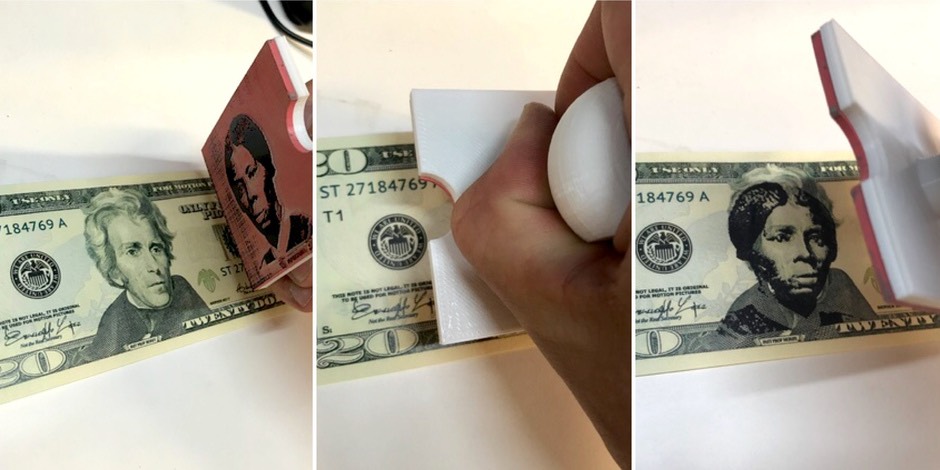
Frustrated that the US Treasury Department is walking back plans to replace Andrew Jackson on the front of the $20 bill with Harriet Tubman, Dano Wall created a 3D-printed stamp that can be used to transform Jacksons into Tubmans on the twenties in your pocketbook.
I was inspired by the news that Harriet Tubman would replace Andrew Jackson on the $20 bill, and subsequently saddened by the news that the Trump administration was walking back that plan. So I created a stamp to convert Jacksons into Tubmans myself. I have been stamping $20 bills and entering them into circulation for the last year, and gifting stamps to friends to do the same.
You claim, on the opinion pages of the “failing” New York Times no less, that senior officials working for the president of the United States “are working diligently from within to frustrate parts of his agenda and his worst inclinations.”
“I would know,” you add dramatically. “I am one of them.”
Sorry, what was the point of this particular piece? And what is it that you want from the rest of us? A thank-you card? A round of applause? The nation’s undying gratitude?
Screw. You.
There is no redemption; no exoneration for you or your colleagues inside this shit-show of an administration. You think an op-ed in the paper of record is going to cut it? Gimme a break. You cannot write an article admitting to the president’s “anti-democratic” impulses while also saying you want his administration “to succeed.” You cannot publish a 965-word piece excoriating Donald Trump’s “worst inclinations” while omitting any and all references to his racism, bigotry, Islamophobia, anti-Semitism, and white nationalism.
You did find space, however, to heap praise on yourself and your fellow officials. “Unsung heroes.” “Adults in the room.” “Quiet resistance.” “Steady state.”
The reality is that you and your fellow officials are enablers of Trump; you are his protectors and defenders. You say it yourself. Why were there only “whispers within the cabinet of invoking the 25th Amendment,” which provides for the cabinet to remove the president from office if he is unable to do the job? Why not invoke it and let Mike Pence take over? (Are you, by the way, Mike Pence?)
If as you claim — and we all agree! — that the president you serve “continues to act in a manner that is detrimental to the health of our republic” with “misguided impulses,” then how can you advocate for anything other than his swift removal from office?
Your defense is that “no one wanted to precipitate a constitutional crisis.” Seriously? You don’t agree with former Secretary of State John Kerry that we’re already in the midst of “a genuine constitutional crisis,” given your own op-ed outlining his “erratic behavior” and “reckless decisions” and Bob Woodward’s new book describing “an administrative coup d’etat” and a “nervous breakdown” at the center of the Trump White House?
You are keen to remind the liberal readers of the New York Times that yours “is not the popular ‘resistance’ of the left” and that you believe this administration’s policies have “already made America safer and more prosperous.” You cite “historic tax reform” and “effective deregulation” as the supposed “bright spots that the near-ceaseless negative coverage of the administration fails to capture.” But by tax reform, do you mean the Trump tax cuts that give the richest 1 percent of Americans almost half of the benefits? And by deregulation, do you mean the rescinding of Obama-era protections for the oceans; the lifting of controls on toxic air pollution; and the green light to Wall Street to once again cause havoc in the financial markets?
What is it, then, that you object to? Well, it seems, your biggest concern is “not what Mr. Trump has done to the presidency,” but how Americans have “sunk low with him and allowed our discourse to be stripped of civility.”
Also, what did you think would happen when you signed up to work for a reality TV star who was accused of sexual assault by more than a dozen women, and of rape by his first wife? Who stiffed hundreds of contractors, ripped off Trump University students, cheated on his third wife just months after she gave birth, and cut off health care coverage to his own nephew’s sick baby in a fit of rage?
You knew all of this and yet you still chose to work for him at the highest level of government. You now acknowledge that “the root of the problem is the president’s amorality.” But how about your own amorality? I hate to agree with your boss, but you are “gutless.” You’re a shameless coward, a cynical opportunist.
Don’t hide behind anonymity. Don’t pretend that you have “gone to great lengths” to restrain Trump and “put country first.”
Tell us your name. Quit your job. Call out this president in public.
Call him out for his bigotry, his mendacity, his sheer mental and emotional unfitness for the office he occupies. Call him out in front of a congressional committee. Or a court of law.
For decades, American historians have viewed the summit between John F. Kennedy and Nikita Khrushchev, in 1961, as the worst ever between the U.S. and Moscow. That disastrous bit of summitry has now been topped by Trump.
“Trump Administration officials are acting as if there were a secure system in place for dealing with children who are taken away from their parents at the border when there is not.” Read more.
“They tell her to sleep, but that can’t be right. First she has to find her son, who is supposed to be here, too. They were separated along the way, overnight, a few days ago.” Read more.
“In the past decade, a growing number of immigrants fearing for their safety have come to the U.S., only to be sent back to their home countries—with the help of border agents, immigration judges, politicians, and U.S. voters—to violent deaths.” Read more.
“Nobody thought that it was good policy to separate parents from children—not immigration officials, not immigrant advocates, not Congress.” Read more.
“Uppgivenhetssyndrom, or resignation syndrome, is an illness that is said to exist only in Sweden, and only among refugees. The patients have no underlying physical or neurological disease, but they seem to have lost the will to live.” Read more.
if you didn’t believe that England hates Donald Trump already: the most recent news of his visit today is that the mayor of London approved protestors releasing a £16,000 Trump in-a-diaper balloon to fly 98ft above ground when he visits, and literally no British person is surprised. Welcome to London.
I’m literally not kidding
the people who are managing the balloon are called trump babysitters. I’ve never loved my country more.
i fucking love this country. Trust us to make the president feel welcome
the best part about this is that trump expected to have a royally welcome visit but as soon as he made an appearance, thousands of angry British people started chanting “fuck trump!” on repreat for hours.
UPDATE: Trump has managed to generate a bigger crowd than Obama did, but for all the wrong reasons. The entirety of London is filled with angry anti-trump protestors, to the point where he is refusing to make an appearance due to fear for his safety.
Here are some fucking awesome protest signs being shown today. I hope we’ve made you proud!
How much would it cost to bring the Giant Baby to The States?
Or to make a few of our own?
Okay I know I just reblogged this earlier. but I just realized that thw “all in all you’re just another prick with no wall” sign is being held by Tony Robinson, known to many as Baldric from Black Adder, and a huge portion of my childhood from Saturday morning cartoons.
Of course Kavanaugh is going to overrule Roe v. Wade. They’ve got four votes already who are willing to uphold a Texas law that was just a sham law intended to shut down abortion clinics. Kavanaugh is going to be the fifth. He has criticized Roe v. Wade. He said that it was a freewheeling decision. He wrote an opinion just last year that took a very aggressive posture, said that the Trump administration could literally imprison women to delay their ability to have an abortion… There’s two Republican senators—Susan Collins and Lisa Murkowski—who claim to be pro-choice. And at the very least, they want to have deniability if they vote for Kavanaugh. But there’s no deniability here. This guy is the fifth vote to overrule Roe v. Wade, period.
Ian Millhiser of ThinkProgress on Trump’s nomination of right-wing Judge Brett Kavanaugh to the Supreme Court. Yesterday we spent the show looking at Kavanaugh’s record—watch or read the coverage here. (via democracynow)
As the political season heats up,
Trump is ramping up his lies through his three amplifiers: Fox News, rallies,
and Twitter.
According to The Fact
Checker’s database, the average daily rate of Trump’s false or misleading claims is climbing.
The problem isn’t just the number
or flagrancy of the lies – for example, that Putin and the Russians didn’t intervene
in the 2016 election on behalf of Trump, or that the Mueller investigation is
part of a Democratic plot to remove him.
And it’s not just that the lies
are about big, important public issues – for example, that immigrants commit
more crimes than native-born Americans, or trade wars are harmless.
The biggest problem is the lies aren’t subject to the filters traditionally applied to presidential
statements – a skeptical press, experts who debunk falsehoods, and respected
politicians who publicly disagree.
The word “media” comes from the
term “intermediate” – that is, to come between someone who makes the news and
the public who receives it.
But Trump doesn’t hold press
conferences. He doesn’t meet in public with anyone who disagrees with him. He denigrates the mainstream press. And he shuns experts.
Instead, his lies go out to tens
of millions of Americans every day unmediated.
TV and radio networks simply rebroadcast his rallies, or portions of them.
At his most recent rally in Great
Falls, Montana, Trump made 98 factual statements.
According to the Washington Post’s fact checkers, 76 percent of them were
false, misleading or unsupported by evidence.
For example, Trump claimed
that “winning the Electoral College is very tough for a
Republican, much tougher than the so-called ‘popular vote,’ where people vote
four times, you know.”
Meanwhile, over 50 million
Americans receive his daily tweets, which are also brimming with lies.
Recently, for example, Trump tweeted that Democrats were responsible for his administration’s policy
of separating migrant families at the border (they weren’t), and that “crime in
Germany is way up” because of migration (in fact, it’s down).
Around 6 million Americans
watch Fox News each day and relate what they see and hear to their friends and
relations.
Fox News is no longer
intermediating between the public and Trump. Fox News is Trump. Trump takes many of his lies from Fox News, and Fox News amplifies Trump’s lies.
Fox News’s Sean Hannity is one of
Trump’s de facto top advisers. Trump has
just appointed Bill Shine, the former number two at Fox News, as his deputy
chief of staff for communications.
No democracy can function under
a continuous bombardment of unmediated lies.
So what are we to do, other than
vote November 6 to constrain Trump?
First, boycott Fox News’s major
sponsors, listed here. Vote with your wallet and starve the
beast. Get others to join you.
Second, attend Trump’s rallies,
as distasteful as this may be. You’re entitled to attend. He is, after all, the
president of the entire country.
Organize and mobilize large
groups to attend with you. Once there, let your views about his lies be heard
and seen by the press. You can find out when and where his rallies will occur here.
Third, sign up for his tweets, and
respond to his lies with the simple: “b.s.” You can sign up here.
Fourth, write to Twitter and tell its executives to stop enabling Trump’s lies. Its contact information is here.
In addition, as the Times’ Farhad Manjoo suggested recently, Twitter’s employees should be encouraged to
make a ruckus – as did Amazon workers who pushed the firm to stop selling
facial recognition services to law enforcement agencies, and Google employees
who pressured Google not to renew a Pentagon contract for artificial
intelligence.
Twitter defines its mission as
providing a “healthy public conversation.” Let them know that demagoguery isn’t
healthy.
Your vote on November 6 is the key,
of course.
But as the political season heats
up, Trump’s lies are heating up, too. And they will sway unwary voters.
So you need to be active now, before
Election Day – on behalf of the truth.
My friends, this is a dark hour. Intolerance, cruelty, racism, misogyny, xenophobia, and environmental destruction have been let loose across the land.
Trump controls the Republican Party, the Republican Party controls the House and Senate, and the Senate and Trump will soon control the Supreme Court.
Republicans also control both chambers in 32 states (33 if you count Nebraska) and 33 governorships. And in many of these states they are entrenching their power by gerrymandering and arranging to suppress votes.
Yet only 27 percent of Americans are Republican, and the vast majority of Americans disapprove of Trump. The GOP itself is now little more than Trump, Fox News, a handful of billionaire funders, and evangelicals who oppose a woman’s right to choose, gay marriage, and the Constitution’s separation of church and state.
So what are we – the majority – to do?
First and most importantly, do not give up. That’s what they want us to do. Then they’d have no opposition at all.
Second, in the short term, if you are represented by a Republican senator, do whatever you can to get him or her to reject Trump’s Supreme Court nominee, or, at the least, postpone consideration until after the midterm elections. Urge others to join with you. Senate switchboard: 202-224-3121
Fourth, don’t succumb to divisive incrimination over “who lost” the 2016 election (Hillary loyalists, Bernie supporters, Jill Stein voters, etc.). This will get us nowhere. We must be united.
Fifth, vote this November 6 for people who will stand up to the Trump Republican outrage. Mobilize and organize others to do so. Contact friends and relations in “red” states, and urge them to do the same.
Sixth, help lay the groundwork for the 2020 presidential election, so that even if Trump survives Mueller and impeachment he will not be reelected.
Finally, know that this fight will be long and hard. It will require our patience, our courage, and our resolve. The stakes could not be higher.
I’ve been meeting women who are crying so violently they can barely speak. I’m meeting women whose hands are shaking, who look at me with kind of a vacant gaze. It’s extremely upsetting to see.
Last week, it emerged that the U.S. Citizenship and Immigration Service (U.S.C.I.S.) had formed a task force in order to identify people who lied on their citizenship applications and to denaturalize them. Amid the overwhelming flow of reports of families being separated at the border and children being warehoused, this bit of bureaucratic news went largely unnoticed. But it adds an important piece to our understanding of how American politics and culture are changing.
A youth care worker who quit his job at a Tucson detention center for unaccompanied minors is speaking out about inadequate facilities, untrained staff and inhumane policies, after witnessing the devastation of family separations firsthand. Antar Davidson says he quit after he was forced to tell three tearful children who were separated from their mother not to hug one another. The facility is run by Southwest Key, a nonprofit that operates 27 facilities and has recently signed a lease to detain hundreds of separated children, including many who are a younger than 12 years old, in what’s being called a “baby jail” in a former warehouse and homeless shelter in Houston.
Antar Davidson told Democracy Now!:
“I realized that if I were to continue with Southwest Key, at least here in this facility, that I’d be told to do things that were… against the code of all humans’ morality… We’re not talking about an organization that was good. We’re talking about an organization that, for the past five years, has made millions of dollars in basically the detention of youth.”


























 House of Brat