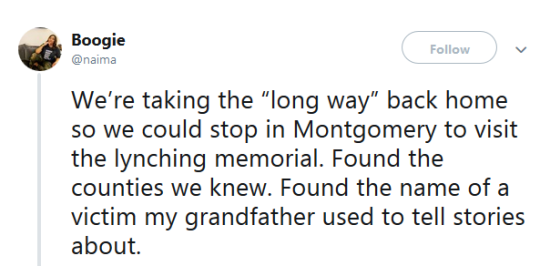
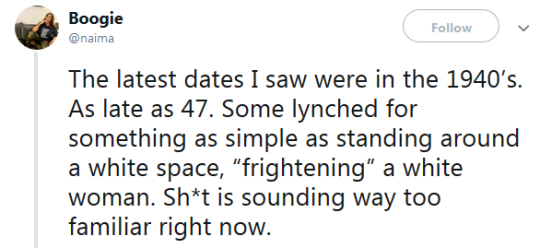
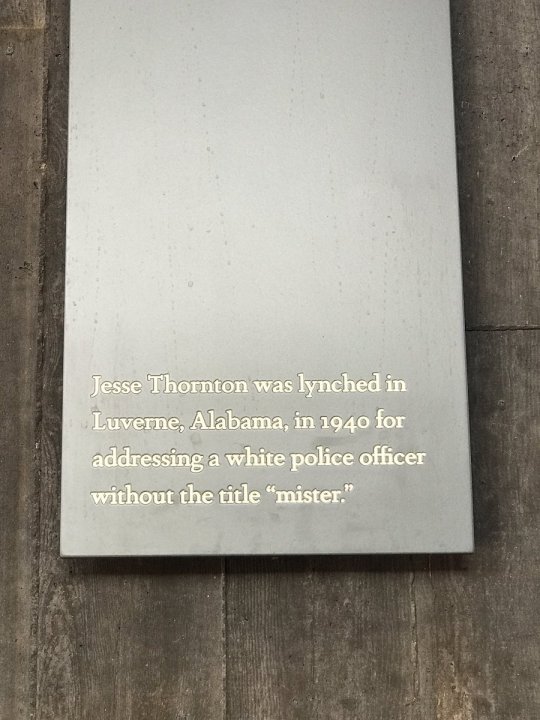
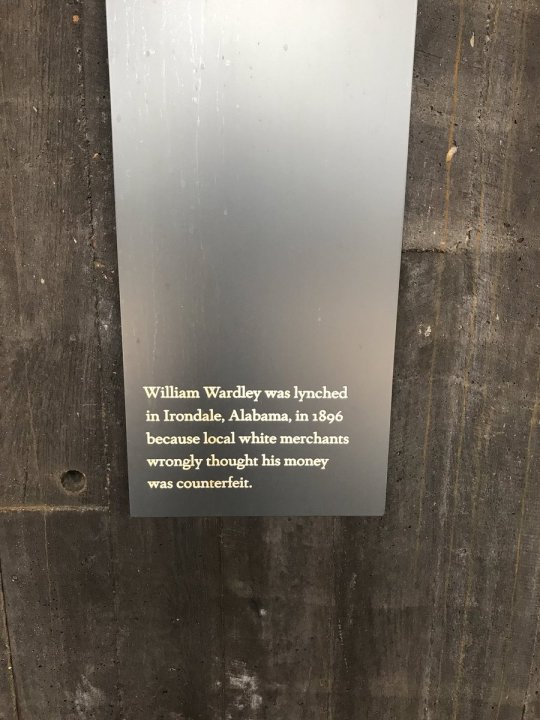
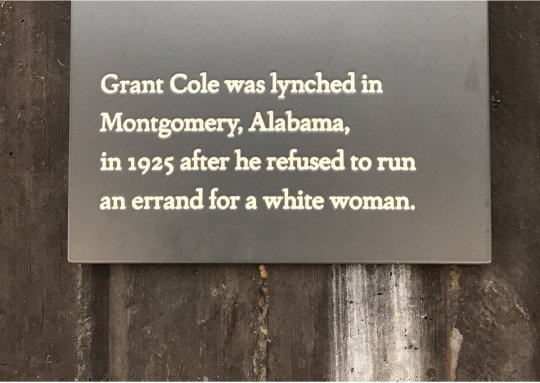
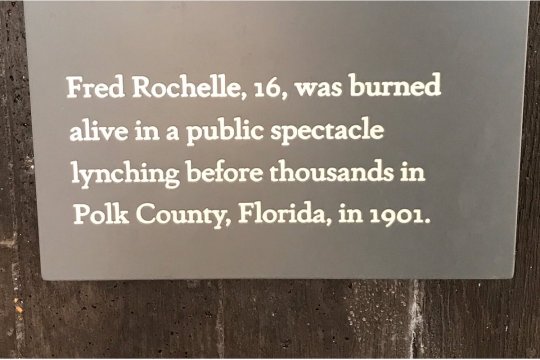
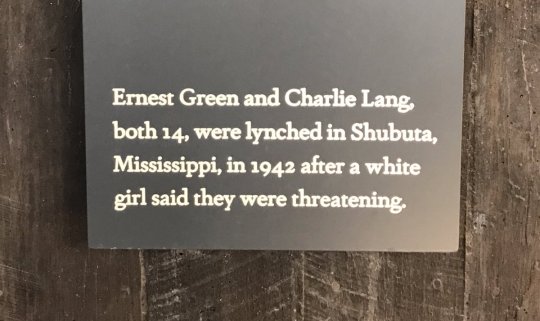
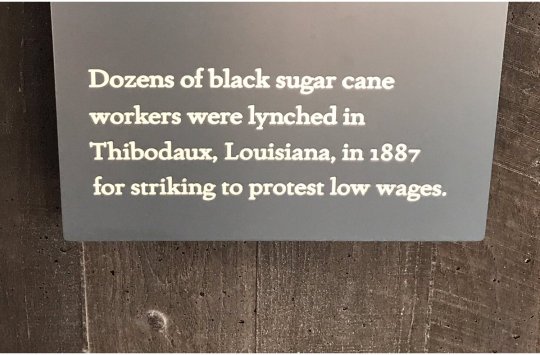
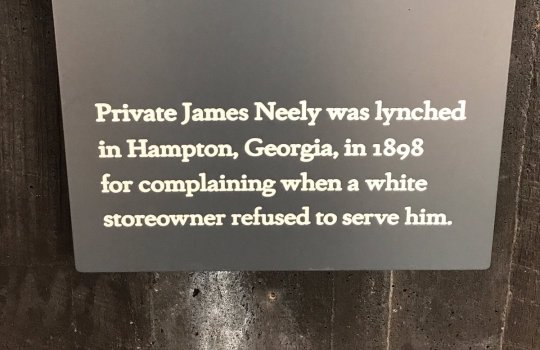
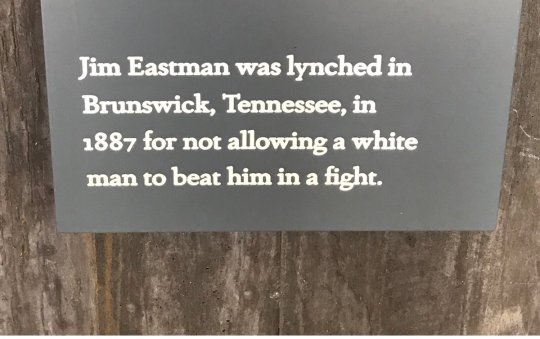
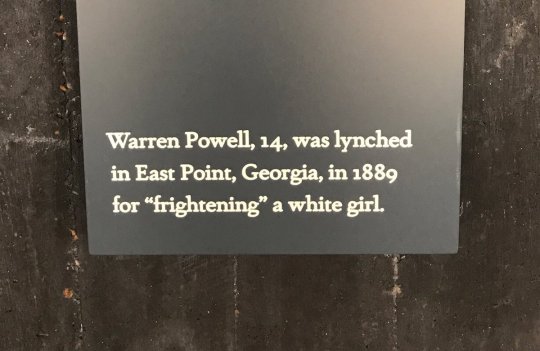
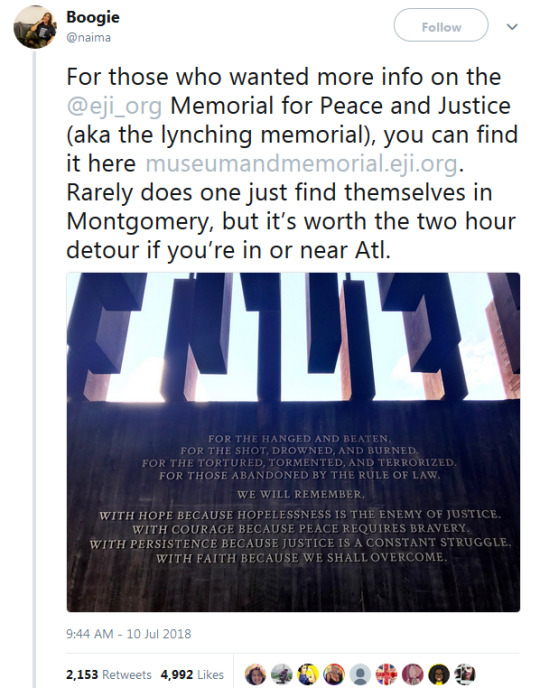
A gentle reminder that the “last lynchings” were between 1981-1991, so
it’s less than 40. The CRA act was passed 54 years ago. Not enough
people want to hear or remember that.
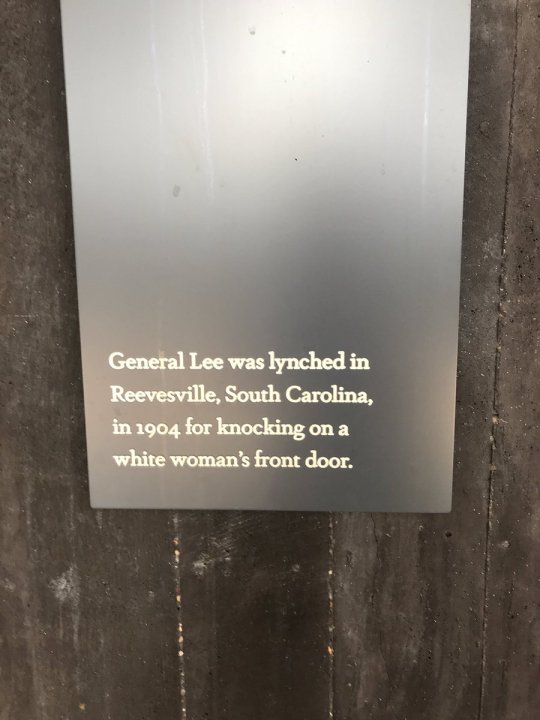
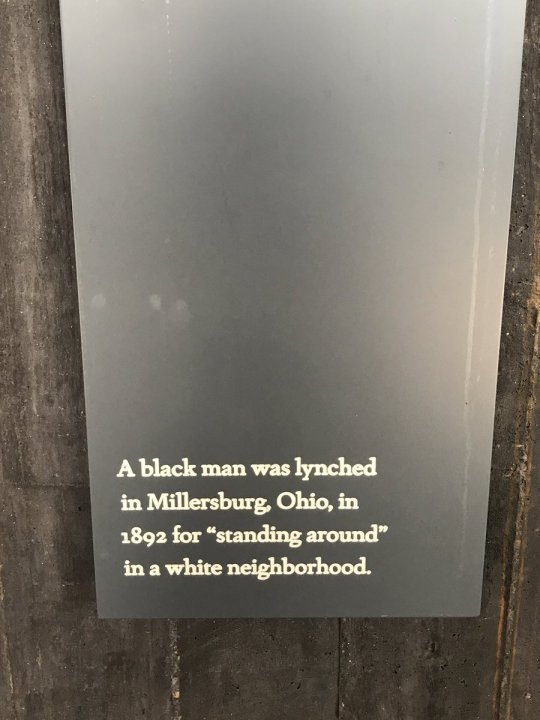
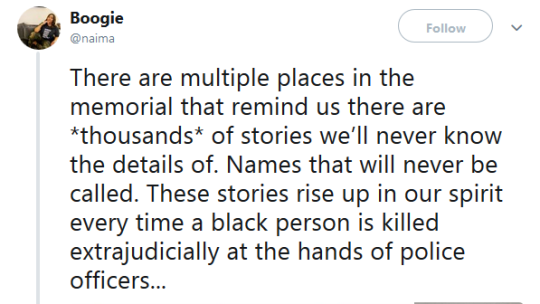
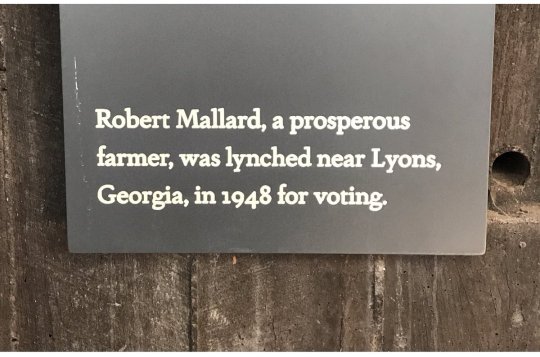
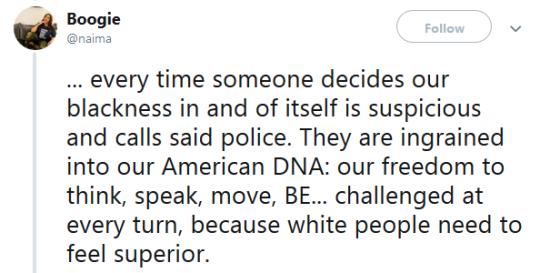
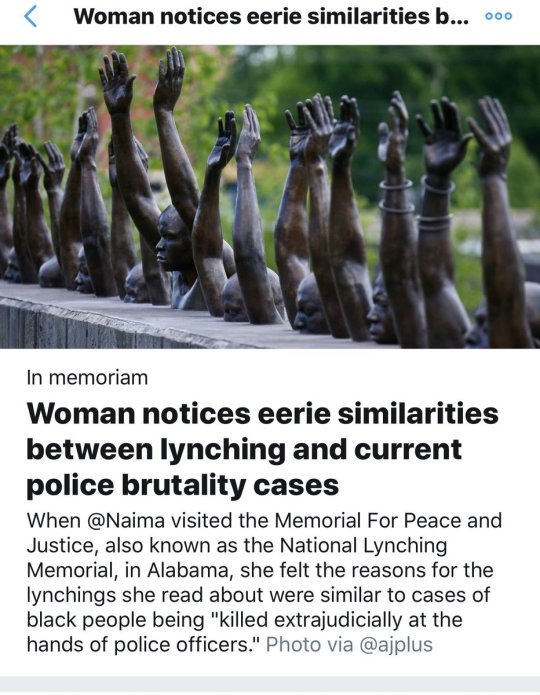
Nah black people still get lynched to this day. Multiple cases this year alone. The police just say they committed suicide. But they committed suicide in public places in the middle of the night..by hanging themselves. The police just cover the shit up because they’re in on it. If it’s deemed a suicide they don’t have to investigate. Case closed.
It’s amazing that we only want equality and not revenge.
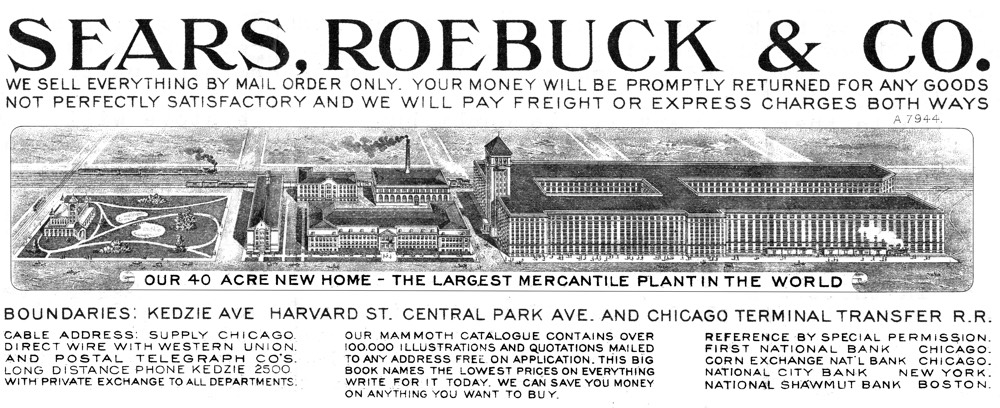
Sears has filed for bankruptcy protection and plans to close hundreds of stores in an effort to keep the company afloat. The Sears catalog is perhaps one of the most important and under-appreciated innovations in American life. Starting in 1888 with a mailer advertising watches and jewelry, Sears introduced millions of Americans to in-home shopping by using the growing networks of the railroad and US Postal Service, much like Amazon and other retailers would using the internet decades later.
The time was right for mail order merchandise. Fueled by the Homestead Act of 1862, America’s westward expansion followed the growth of the railroads. The postal system aided the mail order business by permitting the classification of mail order publications as aids in the dissemination of knowledge entitling these catalogs the postage rate of one cent per pound. The advent of Rural Free Delivery in 1896 also made distribution of the catalog economical.
Every time a black southerner went to the local store they were confronted with forced deference to white customers who would be served first. The stores were not self-service, so the black customers would have to wait. And then would have to ask the proprietor to give them goods (often on credit because…sharecropping). The landlord often owned the store. In every way shopping reinforced hierarchy. Until Sears.
The catalog undid the power of the storekeeper, and by extension the landlord. Black families could buy without asking permission. Without waiting. Without being watched. With national (cheap) prices!
This excellent piece by Antonia Noori Farzan has more info. Reading this, I couldn’t help but think of blind auditions, the practice of auditioning orchestra musicians behind a screen to help cut down on gender bias during the hiring process. While not entirely free of bias – opportunities for discrimination by postal workers and Sears employees were still possible – the Sears ordering process was essentially a blind retail transaction, a screen placed between the store and black customers. (The catalog also advertised racist costumes so obviously Sears wasn’t some bastion of social progressivism…they simply wanted to sell more goods to more kinds of people.)
One of Hancock’s discoveries was Sears’ response to the needs of a rural South in which literacy was rare. For someone who could neither read nor write, placing orders and following written protocols were problematic. Richard Sears responded with a policy that his company would fill any order it received, no matter what the medium or format. So, country folks who were once too daunted to send requests to other purveyors could write in on a scrap of paper, asking humbly for a pair of overalls, size large. And even if it was written in broken English or nearly illegible, the overalls would be shipped.
With Sears declaring bankruptcy, it’s worth remembering how much impact this company had on American music. In my research into blues and other traditional styles, I found that many, many musicians started out on Sears instruments.
Even under Jim Crow, music was an avenue for upward mobility for African Americans, and Sears and other mail-order retailers were more than happy to provide them with instruments.
“It’s hard to make time for history books when there is so much history crashing down on us every single day — and especially when that history is divisive, aggressive and seemingly never-ending,” says NPR’s Congressional correspondent Scott Detrow.
Case in point: This book review was due a week ago. Rather than finish this assignment, I spent the week in Senate hallways and hearing rooms, watching in real time as the most contentious Supreme Court confirmation in a generation turned into a national flashpoint on sexual assault and gender politics.
Luckily, he says, three of America’s most prominent and accessible historians are here to help us put everything in context – check out his full roundup here.
I believe that this nation should commit itself to achieving the goal, before this decade is out, of landing a man on the moon and returning him safely to the earth.
A little more than 8 years later, it was done. On July 20, 1969, 49 years ago today, Neil Armstrong and Buzz Aldrin landed on the Moon, took a walk, and returned safely to Earth a few days later. And the whole thing was broadcast live on television screens around the world.
4:10:30 pm: Moon landing broadcast starts
4:17:40 pm: Lunar module lands on the Moon
4:20:15 pm: Break in coverage
10:51:27 pm: Moon walk broadcast starts
10:56:15 pm: First step on Moon
11:51:30 pm: Nixon speaks to the Eagle crew
12:00:30 am: Broadcast end (on July 21)
You can add these yearly recurring events to your calendar: Moon landing & Moon walk.
Here’s what I wrote when I launched the project, which is one of my favorite things I’ve ever done online:
If you’ve never seen this coverage, I urge you to watch at least the landing segment (~10 min.) and the first 10-20 minutes of the Moon walk. I hope that with the old time TV display and poor YouTube quality, you get a small sense of how someone 40 years ago might have experienced it. I’ve watched the whole thing a couple of times while putting this together and I’m struck by two things: 1) how it’s almost more amazing that hundreds of millions of people watched the first Moon walk *live* on TV than it is that they got to the Moon in the first place, and 2) that pretty much the sole purpose of the Apollo 11 Moon walk was to photograph it and broadcast it live back to Earth.
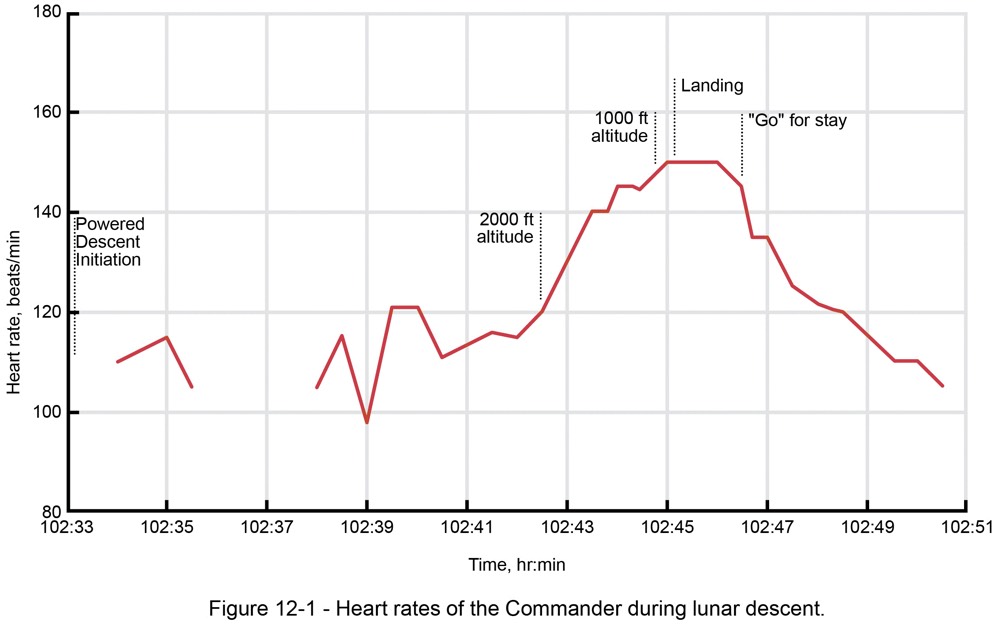
I’ve been listening to the audiobook of Andrew Chaikin’s account of the Apollo program, A Man on the Moon, and the chapter about Apollo 11’s Moon landing was riveting.1 I’ve watched the TV footage & listened to the recordings dozens of times and I was still on the edge of my seat, sweating the landing alongside Armstrong and Aldrin. And sweating they were…at least Armstrong was. Take a look at his heart rate during the landing; it peaked at 150 beats per minute at landing (note: the “1000 ft altitude” is mislabeled, it should be “100 ft”):
For reference, Armstrong’s resting heart rate was around 60 bpm. There are a couple of other interesting things about this chart. The first is the two minutes of missing data starting around 102:36. They were supposed to be 10 minutes from landing on the Moon and instead their link to Mission Control in Houston kept cutting out. Then there were the intermittent 1201 and 1202 program alarms, which neither the LM crew nor Houston had encountered in any of the training simulations. At the sign of the first alarm at 102:38:26, Armstrong’s heart rate actually appears to drop. And then, as the alarms continue throughout the sequence along with Houston’s assurances that the alarm is nothing to worry about, Armstrong’s heart rate stays steady.
Right around the 2000 feet mark, Armstrong realizes that he needs to maneuver around a crater and some rocks on the surface to reach a flat landing spot and his heart rate steadily rises until it plateaus at the landing. At the time, he thought he’d landed with less than 30 seconds of fuel remaining. That Neil Armstrong was able to keep his cool with unknown alarms going off while avoiding craters and boulders with very little fuel remaining and his heart rate spiking while skimming over the surface OF THE FREAKING MOON doing something no one had ever done before is one of the most totally cold-blooded & badass things anyone has ever done. Damn, I get goosebumps just reading about it!
The book is read by Bronson Pinchot, who played Balki Bartokomous on the 80s sitcom Perfect Strangers. He is a fantastic audiobook narrator.↩
The remains of dozens of people found at a construction site in Texas this year are mostly likely those of African-Americans who were forced to work on a plantation there around the turn of the 20th century, officials said this week.
That finding, announced Monday, opens a window onto a little-remembered period in which blacks in certain Southern states were essentially treated like slaves post-emancipation.
The remains of about 95 people were discovered early this year on a construction site outside Houston, where the Fort Bend Independent School District is building a new school, according to school district officials and court records.
This week, archaeologists announced that the bones were most likely those of African-American laborers who worked as part of the so-called convict lease system, in which the state of Texas outsourced prisoners to work and live on plantations. Read more.
“Imagine if people had been going ‘don’t fight hate with hate’ back when Hitler was around.”
Fam…let me tell you bout Poland.
Let me tell you about how the entire rest of Europe sat ack and watched the invasion of Poland because they thought it would be “improper” to send military aid. How they were unwilling to enforce the treaties that Germany was breaking, because that would make them “just as bad.” They sat back and wrote strongly worded letters while fascists grew in power because they didn’t want to dirty their hands. They thought reasonable discussion and politics would be enough to stop a fascist dictator from rising to power.
Spoiler alert: it wasn’t enough.
like yes, people literally did try that argument then too.
Everywhere there’s fascists there are fascist apologists hiding under the guise of pacifism, ready to enable their shit and demonize resistance.
Dr. King used to say you have to be maladjusted to the problems, to the issues that you see around us. Robert Kennedy was maladjusted. Martin Luther King Jr. was maladjusted. They had the ability to get in the way. Today we’re too quiet, we’re too silent. We need to find a way to push and pull, and disturb the sense of false peace, and the sense of false order that we have in our society today. – Rep. John Lewis
Martin Luther King Jr. and more civil rights leaders
meet with Attorney General Robert Kennedy and Vice President Lyndon Johnson at the White House – June 22, 1963
Everybody wants to think that if they were alive during slavery, they’d be an abolitionist. Everybody wants to think that if they were active during the time of lynching, they’d be rallying against and trying to prevent lynchings. Most of us believe that if we were alive and in a position to march in the 1950s, we’d be on the side of Dr. King. But today, we are in the face of all of these problems. One in three black male babies is expected to go to jail or prison. There are these constant shootings of unarmed black people. And the question is: If we’re not prepared to respond to these issues, if we’re not prepared to act today, then I don’t think we can claim that we would have acted any differently during slavery and lynching and segregation.
Eartha Kitt speaking truth to power at a 1968 luncheon at the White House hosted by Lady Bird Johnson which resulted in Kitt being blacklisted in the US for nearly a decade.
let it be known that on January 18th, 1968, Eartha Kitt stood in a room full of white women at The Women Doers Luncheon, GOT IN LADYBIRD JOHNSON’S FACE, and told her that the government was sending the best of the youth off to be shot and killed and, in not so many words, that THAT was the reason the youth were rebelling. She ALSO stopped President Johnson after he made a statement claiming that mothers should be responsible for stopping their kids from becoming criminals and asked about “the parents who have to go to work, for instance, who can’t spend time with their children as they should”. It was brushed off by LBJ who only mentioned the funding for day care centers put in place by the recently passed Social Security bill, and then more or less said that the women at that luncheon should figure it out for themselves.
She was blacklisted, but she defended every word she said that day.




 House of Brat