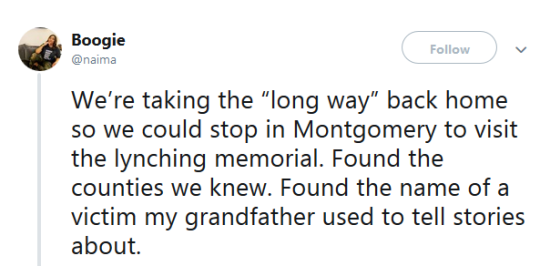
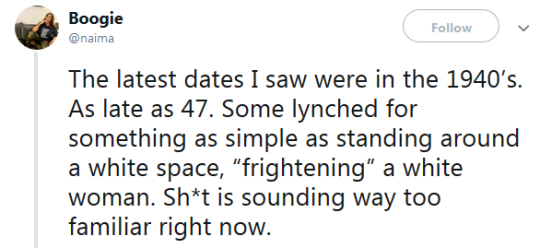
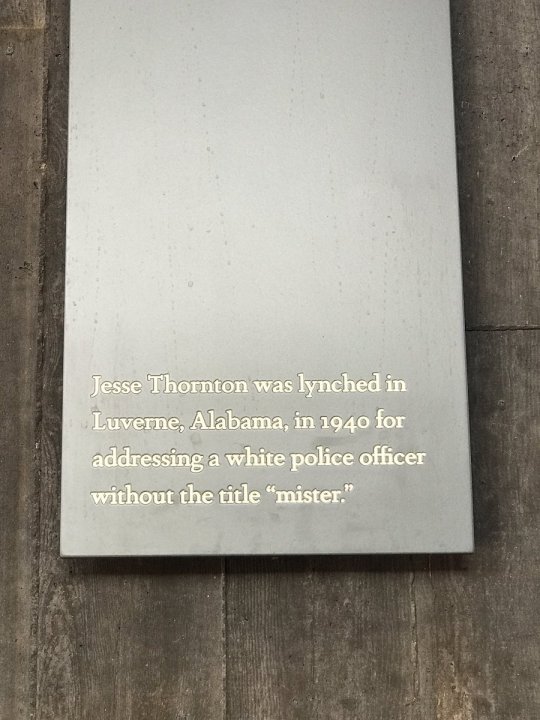
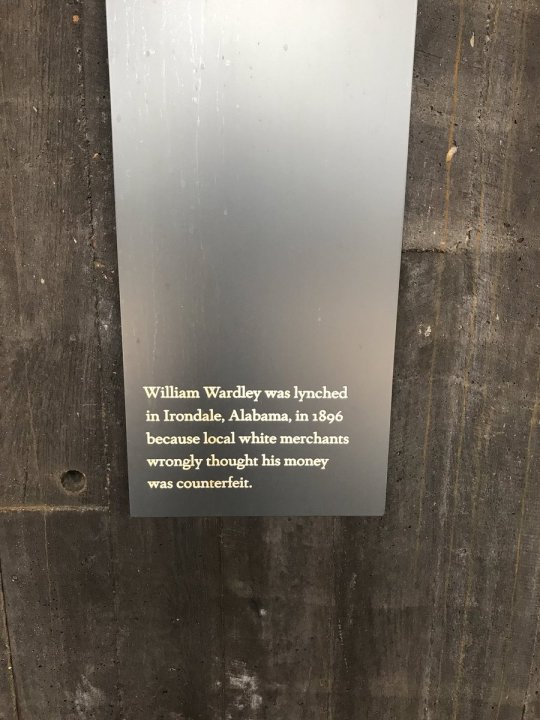
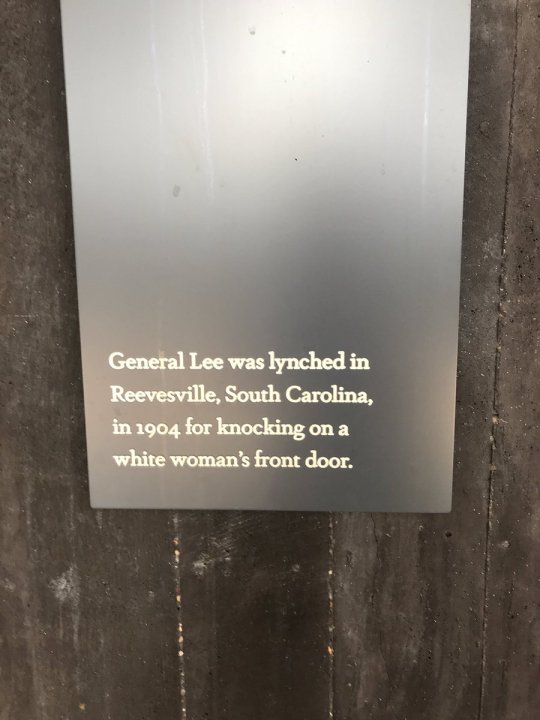
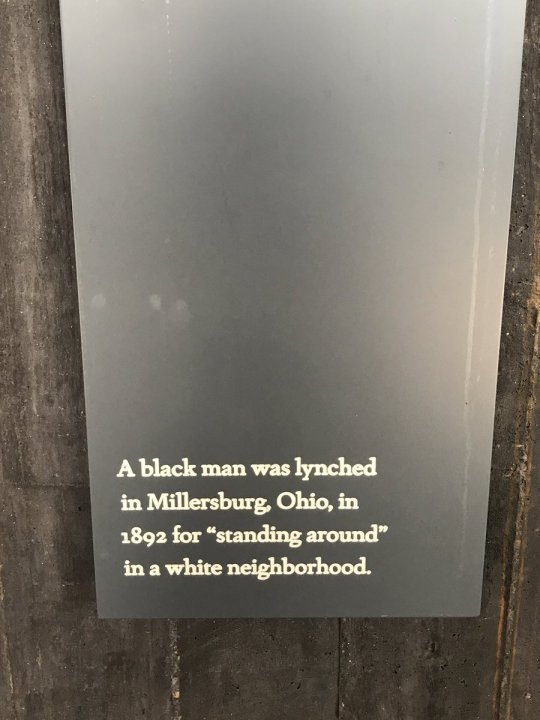
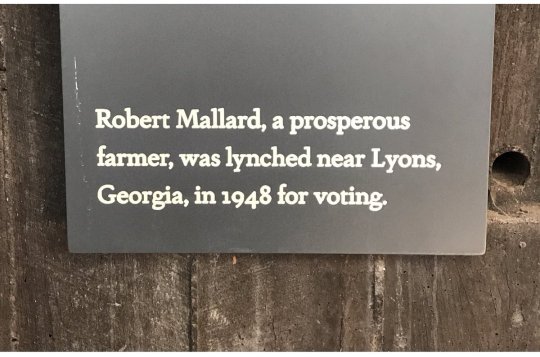
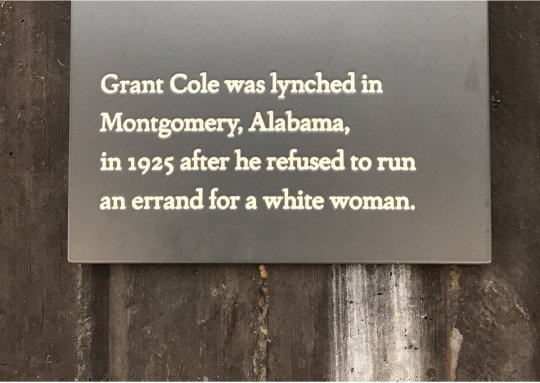
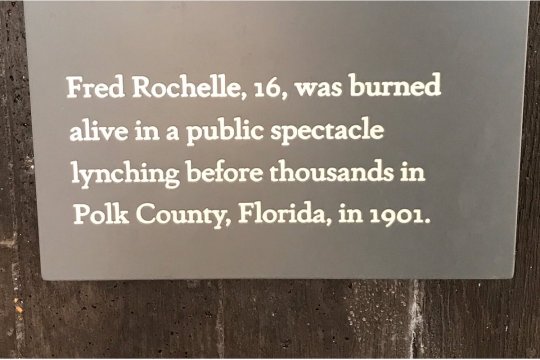
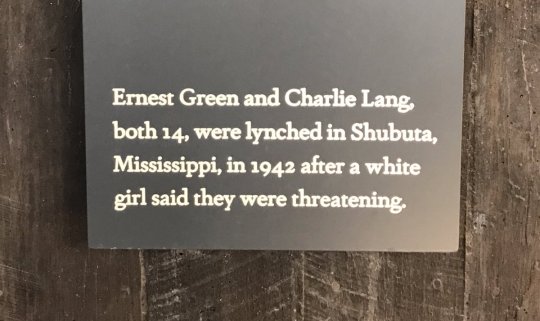
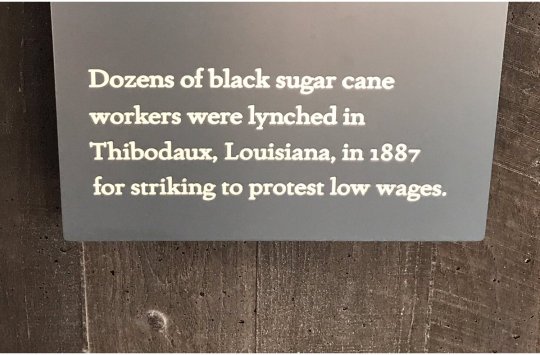
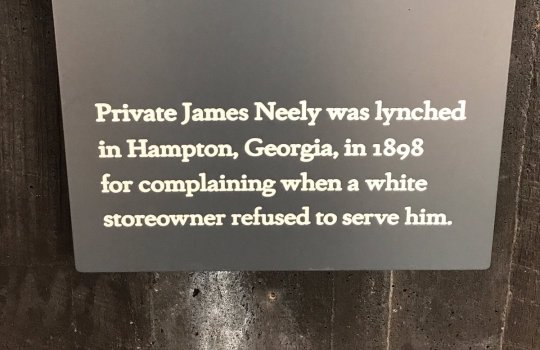
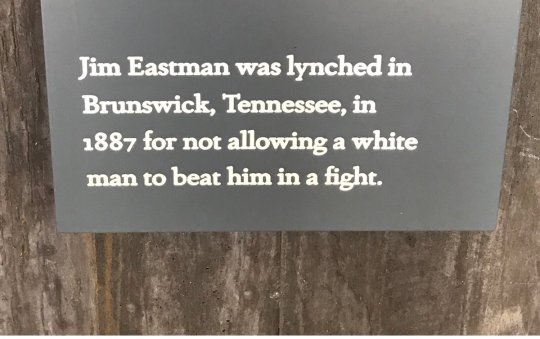
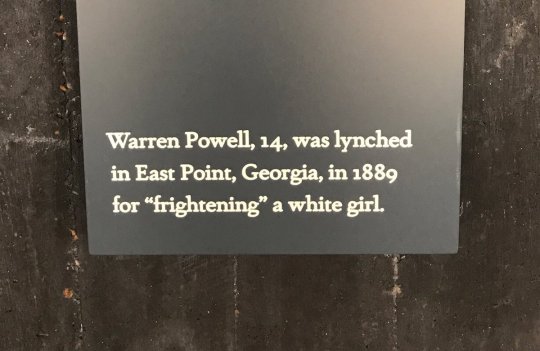
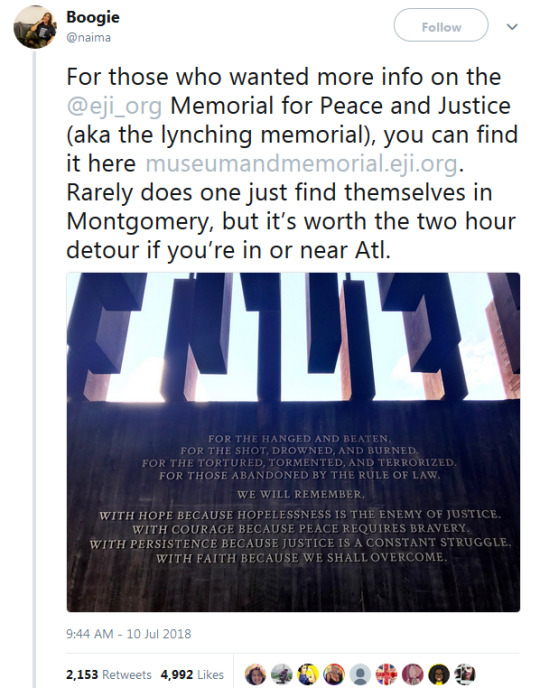
A gentle reminder that the “last lynchings” were between 1981-1991, so
it’s less than 40. The CRA act was passed 54 years ago. Not enough
people want to hear or remember that.
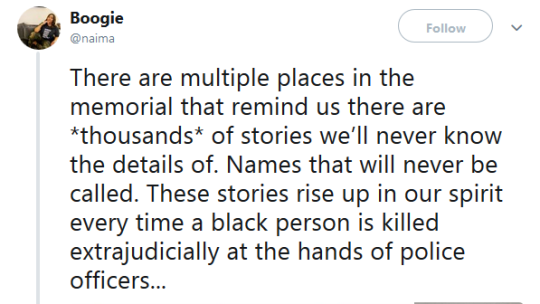
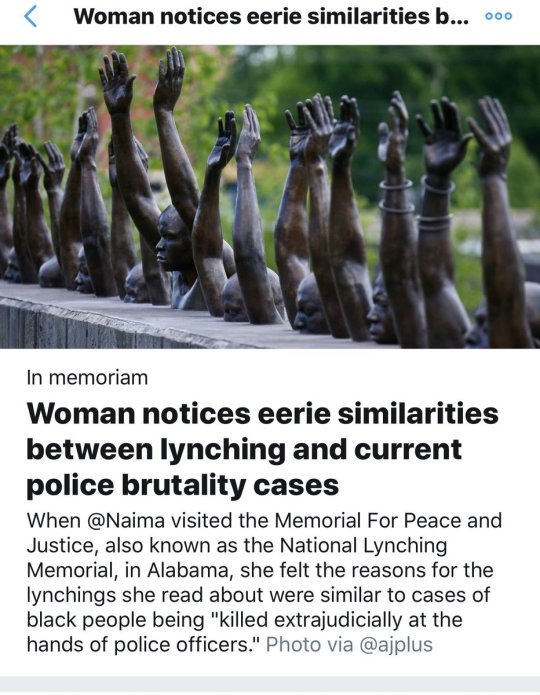
Nah black people still get lynched to this day. Multiple cases this year alone. The police just say they committed suicide. But they committed suicide in public places in the middle of the night..by hanging themselves. The police just cover the shit up because they’re in on it. If it’s deemed a suicide they don’t have to investigate. Case closed.
It’s amazing that we only want equality and not revenge.
Proud of NYC for honoring the women who built this city. Shirley Chisom will receive a permanent monument in Prospect Park. As the first black woman to serve in Congress, she paved the way for the record number of trailblazing women elected to Congress in 2018.
If you watched President George H.W. Bush’s casket arrive in Maryland on Monday and are British, you might have been confused as to why “God Save The Queen” was being played. If you are American like me, you would think nothing of it. You would recognise it as the song “My Country, ‘Tis of Thee” that you sang in many school events growing up.
Former President George Bush Snr’s casket arrives in…
There were 10.7 million unauthorized immigrants in the U.S. in 2016, representing 3.3% of the total U.S. population that year. The 2016 unauthorized immigrant total is a 13% decline from the peak of 12.2 million in 2007, when this group was 4% of the U.S. population.
The number of Mexican unauthorized immigrants declined since 2007, but the total from other nations changed little. Mexicans made up half of all unauthorized immigrants in 2016, according to Pew Research Center’s estimate, compared with 57% in 2007. Their numbers (and share of the total) have been declining in recent years: There were 5.4 million Mexican unauthorized immigrants living in the U.S. in 2016, down from 6.9 million in 2007.
Meanwhile, the total from other nations, 5.2 million in 2016, remained about the same as in 2007, when it was 5.3 million. The number of unauthorized immigrants has grown since 2007 only from one birth region: Central America, from 1.5 million that year to nearly 1.9 million in 2016. This growth was fueled mainly by immigrants from the Northern Triangle nations of El Salvador, Guatemala and Honduras.
The totals also went down over the 2007-2016 period from South America and the combined region of Europe plus Canada. The remaining regions (the Caribbean, Asia, Middle East-North Africa, sub-Saharan Africa and the rest of the world) did not change significantly in that time.
Remember today when you see 100+ articles about how ‘civil’ and ‘noble’ H.W. Bush was that today is World AIDS Day. That 100,000 people, many LGBT+ individuals, especially gay men, died under his and Reagan’s watch. That he banned HIV+ people from entering the US, reduced research funding, and prevented educators from speaking about safe sex in favor of abstinence only education.
By most conventional pundit metrics, Bernie Sanders should be the presumptive 2020 Democratic presidential nominee. To state the obvious, he was last cycle’s runner-up, having won 46 percent of elected delegates, 23 states, and smashed small-dollar fundraising records. His policy platform has taken hold across the party, with most every nationally ambitious figure now calling for universal Medicare, free public college tuition, and a host of other measures that were closely associated with his 2016 run. He has consistently polled as the most popular politician in America, he just won re-election in his home-state by a massive margin, and his social media engagement is off-the-charts. So what’s the problem?
Simply put, large sections of the party still view him as a threat. As much as they’ve attempted to court him, flatter him, and accommodate him in various respects – recall the awkward ‘unity tour’ he held with DNC chairman Tom Perez in 2017 – he is still fundamentally at odds with the interests of the party’s most powerful actors. They might adopt bits and pieces of his agenda, as everyone from New York governor Andrew Cuomo to Nevada senator-elect Jacky Rosen has to varying degrees. And they might offer him polite compliments on the campaign trail, knowing he has an enthused core of supporters. But they will not formally back him in a primary, under virtually any conceivable circumstances. And that’s because for all the kind words Democratic officials have sent his way in the past two years, they are largely just that: words. These entreaties should be seen as attempts at appeasement more than any wholesale endorsement of his basic political program.
Sanders’s economic vision, elementally, is not compatible with the Cuomos and Rosens of the party. He is a socialist, and they are avowedly not. All other considerations around his candidacy can be distilled into that basic, unalterable fact. And this fact is what animates the emerging punditocracy perception of his 2020 prospects. You could almost imagine an alternate universe in which there were demands for the ‘field to be cleared’ for Sanders by virtue of the stature he acquired from the previous cycle. But that’s not happening, and won’t happen, because the ideological chasm he harnessed in 2016 is still there. And it will only continue to widen.
Assumptions about presidential ‘front-runners’ in the political press often derive from the attitudes of party donors, who share their candidate-fancying whims with reporters. This then congeals into a narrative about ‘who’s up and who’s down.’ But Sanders will never be ‘up’ by such a metric, because not only does he have zero interest in supplicating to the party’s donor base – he is actively hostile to them. They were not who he relied on for financial support in 2016, because he pioneered ground-breaking grassroots fundraising tactics which vaulted him to contender status. Central to his overall political vision is doing everything possible to circumvent wealthy donors and diminish their influence.
And these donors are who will continue to shape perceptions of the emerging field among the press. For instance, the FiveThirtyEight politics podcast crew, asked in mid-November to proffer their odds for various Democratic candidates, did not mention Sanders until the third round of their friendly presidential ‘draft’ – almost as if he were a mildly bothersome afterthought. This might be a slightly trivial indicator, but it’s still a reflection of how pundit consensus is overlooking Sanders for a host of reasons – none of which have much to do with empirical reality. In the unreliable yet still extant early polling of the 2020 cycle, Sanders is bouncing around the top, usually just below Joe Biden. But one of the FiveThirtyEight prognosticators picked New York senator Kirsten Gillibrand ahead of him: someone who has done virtually nothing to suggest she has anything close to a formidable national constituency. Sanders, on the other hand, doesn’t have to prove anything in this area: he’s already done it. And yet a slew of new pundit criteria are being formulated to preemptively exclude Sanders, because again, by most conventional metrics he should be deemed the ‘front-runner’ (an admittedly nebulous term). So journalists of various stripes, who have long been instinctively dismissive of him, see no option but to invent brand new metrics.
Dave Wasserman, a Cook Political Report elections data analyst (and typically a very good one), promulgated his conclusion that the ideal opponent for Trump in 2020 must be a young and charismatic female with ‘a natsec background’ and no long history in elected office. Notice that none of these criteria have much to do with policy; it’s on identity grounds that Sanders will probably be most vehemently attacked. He’s too old, white, crotchety, or whatever. But as loud as these criticisms will be, they’ll be underlain by one which is more salient for the power base of the party: the ideological fissure he inescapably represents. People who are most threatened by that might opt for the more superficial arguments against him, because they know Sanders’s socialist vision is increasingly popular with the electorate. But the most central reason for their hostility will always be ideological.
There is another important factor militating against Sanders, at least in the eyes of the opinion-making class. In the 2016 primaries Sanders consistently over-performed with rural white voters, notably in Wisconsin and Michigan, states now crucial to any Democratic victory in 2020. On paper you’d think this would be a huge point in Sanders’s favor, as Democratic losses among that demographic have hobbled their electoral fortunes time after time. But when filtered through the myopic lens of the punditocracy, what might otherwise be regarded as a valuable asset will instead be cast in dark, nefarious terms: as if Sanders’s appeal among these voters makes him vaguely suspicious and perhaps even racist (yes, this will be alleged.)
The 2018 midterms demonstrated that the Democratic party is increasingly anchoring its political support in areas of the country that are highly wealthy, a trend ably described by Matt Karp in Jacobin magazine. He cites Virginia’s 10th congressional district, the richest in the country by median household income, as a case study. This district was one of the night’s most rousing victories for Democrats, with incumbent GOP representative Barbara Comstock dumped decisively for generic Democrat Jennifer Wexton. One could infer, plausibly, that Democrats’ Trump-era messaging has resonated strongest in the country’s most affluent regions – probably due to a combination of cultural aversion to the modern GOP and marginal gripes with the 2017 tax cut bill, which crushed well-off conservative areas in Democratic-leaning states. Now more than at any point in its centuries-old history, Karp declares, Democrats are the ‘party of the prosperous.’
Per the terms of conventional pundit thinking, this bodes ill for Sanders. Sanders has a clear constituency, and it’s emphatically not ‘the prosperous.’ In the 2016 cycle, he frequently trounced Clinton in poor, rural areas, as his landslide victory in the West Virginia primary highlighted. Nationally, the counties in which Sanders performed the best tended to be its most rural and poorest, by median household income. Take California, where he won the five poorest counties by double digits. Conversely, he was battered in the wealthiest counties, where the nucleus of the state’s political power resides – losing rich liberal enclaves like San Francisco, Marin, and San Mateo by huge margins to Clinton.
The rural areas integral to Sanders’s 2016 success are increasingly being written off by Democratic pundits and operatives as unnecessary to forge any winning national electoral coalition. Paul Krugman recently dismissed them as almost intrinsically incorrigible, echoing Clinton’s ‘deplorables’ remark in slightly more charitable terms. And there is some logic to this, however misplaced: Democrats’ biggest gains in the House were disproportionately the very kinds of districts at which Clinton aimed her focus in the 2016 general election – affluent suburbs with tiny shares of persuadable Republicans – to predictably disastrous effect. But now that this narrow approach has yielded geographically-isolated victories in the House, Democrats may reason that Clinton’s strategy wasn’t so bad after all. Consequently, Sanders’s strength among dispossessed rural voters will be argued away, somehow, as a weakness.
With the (hellishly long) 2020 cycle having semi-officially begun, the move will be to pressure Sanders to put aside his ego and bow out for various unpersuasive reasons. Among other tactics, this will take the form of anonymous operatives counseling that he expend his considerable energies on something other than a presidential campaign – the same kind of condescending head-patting that was common in the liberal commentariat during the 2016 run. The logic then was that Sanders should be politely complimented for ‘changing the debate’ in numerous vague respects, but actually supporting his electoral victory was a non-starter. One of the ‘hacked’ emails released by WikiLeaks in 2016 showed Democratic National Committee officials discussing ways to ‘throw [Sanders] a bone’ with meaningless concessions to gain his support, and that attitude will persist as they figure out ways to not-so-gently nudge him from 2020 consideration.
This is all the more ironic, because from a purely electoral standpoint, Sanders stands the best chance against Trump. For one, he is largely unsusceptible to charges of personal hypocrisy – at least by national politicians’ standards – having said much the same thing in public life for several decades. He is not marred by questions around personal corruption, although the FBI investigation into his wife’s land deal in Burlington would have to be affirmatively dealt with at some point. If that’s his one major liability, though, then his liabilities are few – especially compared to the previous Democratic nominee and Trump, whose various personal corruptions could be barely captured by several days’ worth of exhaustive documentation. The age issue will be exhaustively whinged about, but he’s only four years older than the incumbent president, and by all appearances in much better physical shape.
But as much as Democratic power brokers loathe Trump, they can’t countenance Sanders. And their mindset will inform pundit consensus as the hellishly long presidential cycle barrels forward. In Sanders’s calculation, maybe this is for the better. An unambiguous ‘front-runner’ designation would be a mixed blessing, because one of Sanders’s strengths last cycle was how his appeal grew somewhat under the radar, until the evidence for it became impossible to ignore. So it could easily creep up on them again, only this time louder and more determined, backed up by a national infrastructure that didn’t exist in 2016. He also has what amounts to his own sub-rosa alternative media eco-system, which has only grown in the past few years, and some Sanders supporters do now occupy prominent positions in elite journalism, whereas last time there were almost none. So the campaign to disqualify him won’t be easy, but it will be waged vigorously. And that might be exactly what Sanders should want.
“So what can we learn from this study? On the data side, we see that everything is proceeding as planned. Nobody’s paying $50 for a burger at McDonald’s, or $16 for a can of tuna at Safeway. Employers wish their profits were higher, and workers are glad they got a raise, but they wish they made more money. Three years after Seattle started down the road to $15, everything is as it should be. Those apocalyptic claims of destruction and business closures haven’t been proven true. One thing the study didn’t explain was why the sky didn’t fall as promised. Why weren’t workers laid off in droves, or replaced with robots? Why didn’t prices skyrocket? Why does Seattle have more restaurants now than at any point in its history? It’s because those workers who saw a raise now have more money to spend in the city around them. Those restaurant workers are eating in more restaurants. They’re buying more groceries. They’re buying more clothes and cars. That increased consumer demand is creating jobs, and more than paying for the increased minimum wage. The $15 minimum wage established a positive feedback loop that created growth in Seattle by including more people in the economy. In other words, it worked exactly as intended.”
In making plans to celebrate Thanksgiving, don’t forget: November is also Native American Heritage Month. Observing it won’t undo the atrocities that occurred over the past few centuries — or the current threats to Native Americans and their lands, such as the proposed Dakota Access Pipeline — but recognizing and celebrating those who were here first and are now marginalized is an important step in moving things forward. Especially if you missed Native American Day.
Her not making these type of precautions is shady as hell to be honest.
Renouncing citizenship in the US is a big deal. You usually don’t do it unless you absolutely have to, and you can’t get your citizenship back ever. That’s why most people end up having dual citizenship instead and retain original citizenship.
I know right. Stop playing with us Daily Mail..we want the bombshell! Lmao. But I do find it interesting there seems to be a negative story about her every other day now which is crazy. The tides are turning, folks.
Generally, Americans always have to file their taxes with the IRS as long as they are citizens. It doesn’t matter if you’re paying taxes to another country such as the UK.
A new Pew Research Center analysis of Census Bureau data finds that the “post-Millennial” generation is already the most racially and ethnically diverse generation, as a bare majority of 6- to 21-year-olds (52%) are non-Hispanic whites. And while most are still pursuing their K-12 education, the oldest post-Millennials are enrolling in college at a significantly higher rate than Millennials were at a comparable age.
The changing patterns in educational attainment are driven in part by the shifting origins of young Hispanics. Post-Millennial Hispanics are less likely than Millennial Hispanics to be immigrants – 12% of post-Millennial Hispanics were born outside the U.S., compared with 24% of Millennial Hispanics in 2002.
More broadly, the post-Millennial generation is being shaped by changing immigration patterns. Immigration flows into the U.S. peaked in 2005, when the leading edge of the post-Millennial generation was age 8 or younger. The onset of the Great Recession and the large decline in employment led to fewer immigrants coming to the United States, including immigrant children. As a result, the post-Millennial generation has fewer foreign-born youth among its ranks than the Millennial generation did in 2002 and a significantly higher number who were born in the U.S. to immigrant parents, though this may change depending on future immigration flows.
Other key findings:
The oldest post-Millennials are less likely than their predecessors to be in the labor force. Only 58% of today’s 18- to 21-year-olds worked in the prior calendar year; this compares with 72% of Millennial 18- to 21-year-olds in 2002. And employment among post-Millennials is less likely to be full-time compared with earlier generations. This is likely due, in large part, to the fact that these young adults are more likely than their predecessors to be enrolled in college.
The living arrangements of post-Millennial children are similar to those of Millennials when they were growing up. About two-thirds (65%) of today’s 6- to 17-year-olds live with two married parents, slightly lower than the share (68%) of Millennials in that age range who lived in this type of household in 2002. Roughly three-in-ten post-Millennials ages 6 to 17 (31%) live with a single parent, somewhat higher than the share of Millennials growing up with a single parent in 2002 (27%).2
The median household income of post-Millennials exceeds that of earlier generations when they were young. The typical post-Millennial in 2018 lives in a household with an annual income of roughly $63,700 after adjusting for household size. That is slightly higher than the income for the typical household in which Millennials grew up – $62,400 in 2002 in inflation-adjusted dollars – and it far surpasses the income of Gen X and Baby Boomer households when they were growing up. This is consistent with the relatively high education of the parents of post-Millennials.
Sorry to deliver the news, but it’s time to worry about the next crash.
The combination of stagnant wages with most economic gains going to the top is once again endangering the economy.
Most Americans are still living in the shadow of the Great Recession that started in December 2007 and officially ended in June 2009. More have jobs, to be sure. But they haven’t seen any rise in their wages, adjusted for inflation.
Many are worse off due to the escalating costs of housing, healthcare, and education. And the value of whatever assets they own is less than in 2007.Which suggests we’re careening toward the same sort of crash we had then, and possibly as bad as 1929.
Clear away the financial rubble from those two former crashes and you’d see they both followed upon widening imbalances between the capacity of most people to buy, and what they as workers could produce. Each of these imbalances finally tipped the economy over.
The same imbalance has been growing again. The richest 1 percent of Americans now takes home about 20 percent of total income, and owns over 40 percent of the nation’s wealth.
These are close to the peaks of 1928 and 2007.
The underlying problem isn’t that Americans have been living beyond their means. It’s that their means haven’t been keeping up with the growing economy. Most gains have gone to the top.
But the rich only spend a small fraction of what they earn. The economy depends on the spending of middle and working class families.
By the first quarter of this year, household debt was at an all-time high of $13.2 trillion. Almost 80 percent of Americans are now living paycheck to paycheck.
It was similar in the years leading up to the crash of 2007. Between 1983 and 2007, household debt soared while most economic gains went to the top. If the majority of households had taken home a larger share, they wouldn’t have needed to go so deeply into debt.
Similarly, between 1913 and 1928, the ratio of personal debt to the total national economy nearly doubled. After the 1929 crash, the government invented new ways to boost wages – Social Security, unemployment insurance, overtime pay, a minimum wage, the requirement that employers bargain with labor unions, and, finally, a full-employment program called World War II.
After the 2007 crash, the government bailed out the banks and pumped enough money into the economy to contain the slide. But apart from the Affordable Care Act, nothing was done to address the underlying problem of stagnant wages.
Trump and his Republican enablers are now reversing regulations put in place to stop Wall Street’s excessively risky lending.
But Trump’s real contributions to the next crash are his sabotage of the Affordable Care Act, rollback of overtime pay, burdens on labor organizing, tax reductions for corporations and the wealthy but not for most workers, cuts in programs for the poor, and proposed cuts in Medicare and Medicaid – all of which put more stress on the paychecks of most Americans.
Ten years after the start of the Great Recession, it’s important to understand that the real root of the collapse wasn’t a banking crisis. It was the growing imbalance between consumer spending and total output – brought on by stagnant wages and widening inequality.
Forbes recently released their 2019 “30 Under 30” list of “the brashest entrepreneurs across the United States and Canada” who are also under 30 years old. A persistent criticism of the list is that many of the people on it are there because of family or other social advantages. As Helen Rosner tweeted of last year’s list:
My take is: all 30 Under 30 lists should include disclosure of parental assets
In a piece for Vox, Aditi Juneja, creator of the Resistance Manual and who was on the 30 Under 30 list last year, writes that Forbes does ask finalists a few questions about their background and finances but also notes they don’t publish those results. Juneja goes on to assert that no one in America is entirely self-made:
Most of us receive government support, for one thing. When asked, 71 percent of Americans say that they are part of a household that has used one of the six most commonly known government benefits – Social Security, Medicare, Medicaid, food stamps, welfare, or unemployment benefits.
And many people who benefit from government largesse fail to realize it: Sixty percent of Americans who claim the mortgage-interest deduction, which applies to homeowners, say they have never used a government program. If you’ve driven on public roads, gone to public school, or used the postal service as part of your business – well, we all rely on collective infrastructure to get ahead.
And then she lists some of the ways in which she has specifically benefitted from things like government programs, having what sounds like a stable home environment, and her parents having sufficient income to save money for her higher education.
I went to public schools through eighth grade. My parents were able to save for some of my college costs through a plan that provides tax relief for those savings. I stayed on my parent’s health insurance until I was 26 under the Affordable Care Act. I have received the earned income tax credit, targeted at those with low or moderate income. I took out federal student loans to go to law school.
Juneja’s piece reminds me of this old post about how conservatives often gloss over all of the things that the government does for its citizens:
At the appropriate time as regulated by the US congress and kept accurate by the national institute of standards and technology and the US naval observatory, I get into my national highway traffic safety administration approved automobile and set out to work on the roads build by the local, state, and federal departments of transportation, possibly stopping to purchase additional fuel of a quality level determined by the environmental protection agency, using legal tender issed by the federal reserve bank. On the way out the door I deposit any mail I have to be sent out via the US postal service and drop the kids off at the public school.
Or think about the idea of family, in the context of everyday life. It’s one thing to talk about family values as a theme, or a wedge – but what’s it actually like to have a family? Your family does better if you get a fair wage, if there’s good public education, if there’s good health care when you need it. These things intuitively make sense, but we’re out of practice talking about them.
I also think we need to talk about a different kind of patriotism: a fidelity to American greatness in its truest sense. You think about this as a local official, of course, but a truly great country is made of great communities. What makes a country great isn’t chauvinism. It’s the kinds of lives you enable people to lead. I think about wastewater management as freedom. If a resident of our city doesn’t have to give it a second thought, she’s freer.
Lists like 30 Under 30 reinforce the idea of American individualism at the expense of the deep spirit & practice of collectivism that pervades daily American life. America’s fierce individuals need each other. Let’s celebrate and enable that.
Deb Haaland, One of Nation’s First Native Congresswomen, Calls for Probe of Missing Indigenous Women
Newly Elected Native Congresswomen Deb Haaland on Climate Change and Suppression of Native Votes
lynseyaddario: At a cemetery in Georgia in 2016, Lucy McBath weeps over the grave of her son, Jordan Davis, who was killed by a white man at 17 years old at a gas station in Florida after being accused of playing loud music. After her son’s murder, Lucy became a gun control activist, and was just elected to Congress in Georgia. Her win, which unseats Republican Rep. Karen Handel, seems only more poignant the morning after 12 people were gunned down in California.
The census is basically the DNA for our democracy. It is the baseline for which so many things are done. The census determines how $675 billion is distributed to states and localities. The census determines how legislative districts are drawn. The census determines the composition of the Electoral College. So if this question about citizenship is added to the census, places like California and New York and Texas — which actually, funnily enough, is a red state — they could receive fewer members of Congress, they could have less influence in the Electoral College, they could have less money going to their states. And then places like Kansas, where there are fewer immigrants, where it’s a lot whiter and more Republican, they’re going to have more political power if this question about citizenship is added to the census like Kris Kobach wants.
Ari Berman on why the census matters (Kris Kobach, Kansas secretary of state, is an advocate for a question citizenship on the census)
I’ve never seen a purge operation this wide, this big. And this one thing that Stacey Abrams was mentioning during the debate, it’s not just the 53,000 names pending, it’s the 340,000 people purged. That is, their registrations have been canceled.
The movement for a $15-an-hour minimum wage got a boost earlier this month when Amazon – which has drawn criticism for its pay practices and working conditions – announced it would raise its base pay for all U.S. workers to $15 an hour. The new minimum wage takes effect Nov. 1 and will affect some 250,000 full- and part-time employees, as well as the 100,000 or so seasonal workers Amazon expects to hire in the next few months, according to the company. (The raises will be offset, at least in part, by the phasing out of bonuses and stock awards for hourly workers.)
How much of a real improvement those workers will see in their daily lives, however, depends very much on where they live.
HBO guest host Brittany Packnett warned white Republican women that they will not be protected from male oppression just because of the color of their skin.
Packnett, an activist for Teach for America, made the remarks during HBO’s weekly Pod Save American program.
“Let’s talk about our sister Stormy Daniels because she absolutely does not deserve the way that this president has been talking about her,” Packnett said. “But here’s what, frankly, worries me. This ‘president’ – yeah, I used air quotes – he has been talking horribly about women since he was a candidate.”
“He admitted to being a sexual assaulter when he was a candidate and 53 percent of white women went ahead and elected him anyway,” she lamented. “So let me talk to my white sisters for a second. I just want to issue a warning and I hope you are listening closely.”
Packnett continued: “I want you tell your mamas and your aunties and your grandmothers – from me – to stop selling us out! Listen, I know it’s really hard but your whiteness will actually not save you from what patriarchy has for you.”
According to Packett, women should learn from the way Dr. Christine Blasey Ford was treated when she testified against then-Supreme Court nominee Brett Kavanaugh.
“Right?” Packett pointed out. “We all know what happened to her when she decided to stand up and be a patriot in this country and try to save the rest of us.”
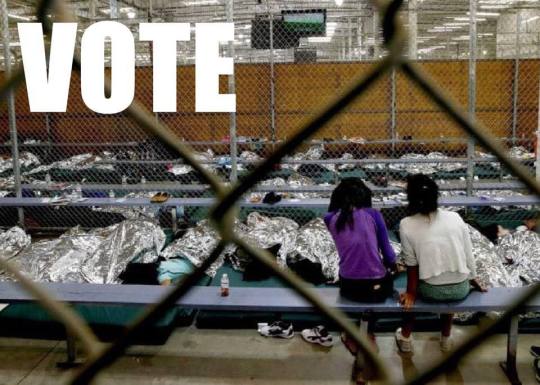
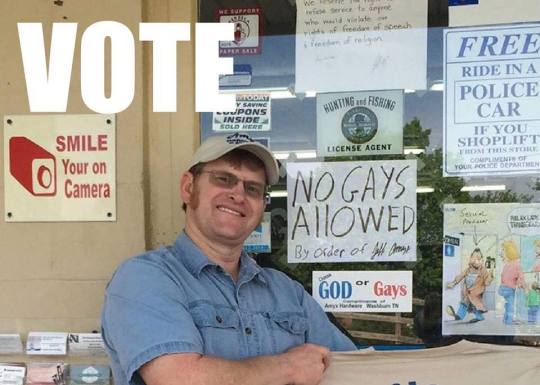
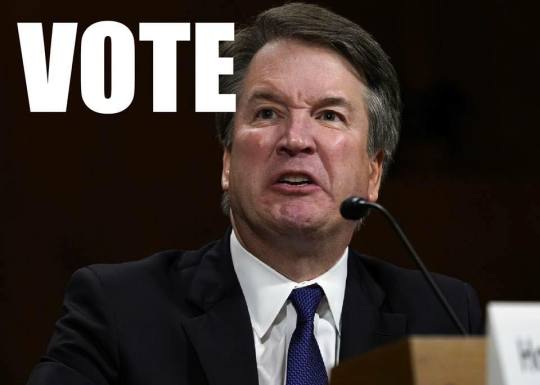
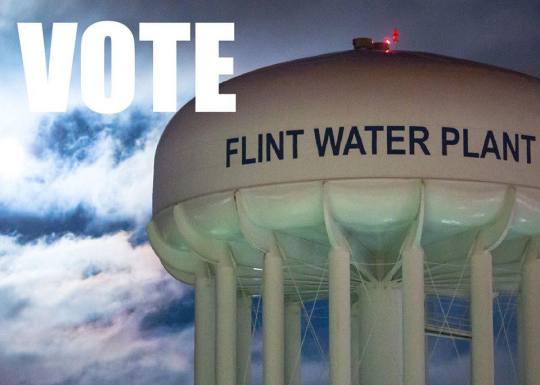
How is that renowned Republican brand working for you? The pictures above are a reminder of past and ongoing Republican actions and inaction so that people will remember them when they get ready to vote.
Sinclair is the largest owner of television stations in the United States, with a 192 stations in 89 markets. It reaches 39% of American viewers. The company’s executive chairman, David D. Smith, is a conservative whose views combine a suspicion of government, an aversion to political correctness, and strong libertarian leanings. An ardent supporter of Donald Trump, he has not been shy about using his stations to advance his political ideology. Sinclair employees say that the company orders them to air biased political segments produced by the corporate news division, and that it feeds interviewers questions intended to favor Republicans.
Sears has filed for bankruptcy protection and plans to close hundreds of stores in an effort to keep the company afloat. The Sears catalog is perhaps one of the most important and under-appreciated innovations in American life. Starting in 1888 with a mailer advertising watches and jewelry, Sears introduced millions of Americans to in-home shopping by using the growing networks of the railroad and US Postal Service, much like Amazon and other retailers would using the internet decades later.
The time was right for mail order merchandise. Fueled by the Homestead Act of 1862, America’s westward expansion followed the growth of the railroads. The postal system aided the mail order business by permitting the classification of mail order publications as aids in the dissemination of knowledge entitling these catalogs the postage rate of one cent per pound. The advent of Rural Free Delivery in 1896 also made distribution of the catalog economical.
Every time a black southerner went to the local store they were confronted with forced deference to white customers who would be served first. The stores were not self-service, so the black customers would have to wait. And then would have to ask the proprietor to give them goods (often on credit because…sharecropping). The landlord often owned the store. In every way shopping reinforced hierarchy. Until Sears.
The catalog undid the power of the storekeeper, and by extension the landlord. Black families could buy without asking permission. Without waiting. Without being watched. With national (cheap) prices!
This excellent piece by Antonia Noori Farzan has more info. Reading this, I couldn’t help but think of blind auditions, the practice of auditioning orchestra musicians behind a screen to help cut down on gender bias during the hiring process. While not entirely free of bias – opportunities for discrimination by postal workers and Sears employees were still possible – the Sears ordering process was essentially a blind retail transaction, a screen placed between the store and black customers. (The catalog also advertised racist costumes so obviously Sears wasn’t some bastion of social progressivism…they simply wanted to sell more goods to more kinds of people.)
One of Hancock’s discoveries was Sears’ response to the needs of a rural South in which literacy was rare. For someone who could neither read nor write, placing orders and following written protocols were problematic. Richard Sears responded with a policy that his company would fill any order it received, no matter what the medium or format. So, country folks who were once too daunted to send requests to other purveyors could write in on a scrap of paper, asking humbly for a pair of overalls, size large. And even if it was written in broken English or nearly illegible, the overalls would be shipped.
With Sears declaring bankruptcy, it’s worth remembering how much impact this company had on American music. In my research into blues and other traditional styles, I found that many, many musicians started out on Sears instruments.
Even under Jim Crow, music was an avenue for upward mobility for African Americans, and Sears and other mail-order retailers were more than happy to provide them with instruments.
The United States, circa 2018, looks like a place run by people who know they’re going to die soon.
As “once in a lifetime” storms crash over our coasts five times a year – and the White House’s own climate research suggests that human civilization is on pace to perish before Barron Trump – our government is subsidizing carbon emissions like there’s no tomorrow. Meanwhile, America’s infrastructure is already “below standard,” and set to further deteriorate, absent hundreds of billions of dollars in new investment. Many of our public schools can’t afford to stock their classrooms with basic supplies, pay their teachers a living wage, or keep their doors open five days a week. Child-care costs are skyrocketing, the birth rate is plunging, and the baby boomers, retiring. And, amid it all, our congressional representatives recently decided that the best thing they could possibly do with $1.5 trillion of borrowed money was to give large tax breaks to people like themselves.
See also Dear Young People: Don’t Vote. As Levitz says though, one of the reasons that young people don’t vote is that it’s often more difficult than for older people. Making it easier for everyone to vote would alleviate many of these concerns and result in higher turnout, more political engagement, and better representation for young Americans.
Millennials in the U.S. are more underrepresented than their peers in most other developed countries. Primary responsibility for this fact lies with our nation’s political parties, which have made America an exceptionally difficult place to cast a ballot. If Democrats wish to increase turnout among the young, they’d be well advised to implement automatic voter registration, a new Voting Rights Act, and a federal holiday on the first Tuesday in November, when and if they have the power to do so.
Voter suppression is often, correctly, viewed through a racial or class-based lens – however, these same laws also target younger people. A group that tends to vote more often for third-party and Democratic candidates.
For example, states such as Texas and Ohio require voter identification at the polling place – a college or university ID doesn’t qualify. In Wisconsin, voter ID laws permitted college IDs but not out-of-state drivers licenses, which, local news reported, resulted in many university students getting turned away in the April 2016 primary. In North Carolina, another key state in the Electoral College, hundreds of students cast provisional ballots in 2016, unsure whether their vote would even count because of their strict voter ID laws – which were struck down this year by the Supreme Court, but not before disenfranchising potentially thousands of American citizens.
“It’s hard to make time for history books when there is so much history crashing down on us every single day — and especially when that history is divisive, aggressive and seemingly never-ending,” says NPR’s Congressional correspondent Scott Detrow.
Case in point: This book review was due a week ago. Rather than finish this assignment, I spent the week in Senate hallways and hearing rooms, watching in real time as the most contentious Supreme Court confirmation in a generation turned into a national flashpoint on sexual assault and gender politics.
Luckily, he says, three of America’s most prominent and accessible historians are here to help us put everything in context – check out his full roundup here.
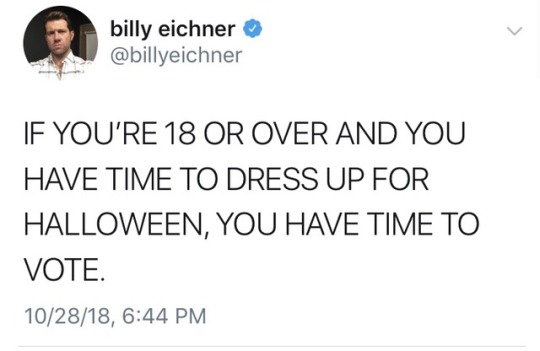
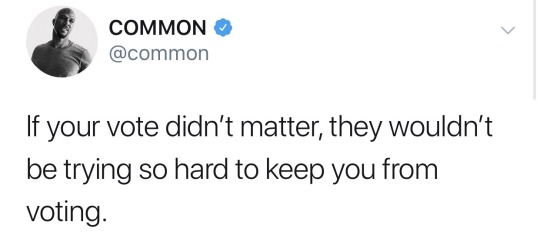
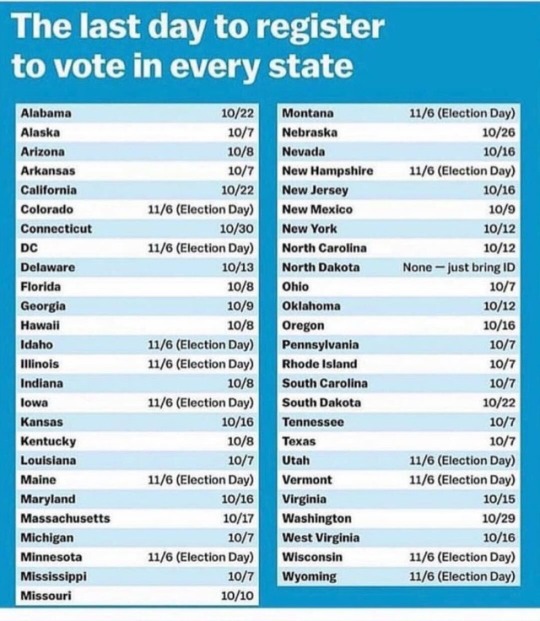
TODAY is the last day to register to vote in the Midterms in some states. Look for your state here…and get on it. Raise your eyes and lift your heart toward the prize. You can register today at marchforourlives.com
If you are bored and disgusted by politics and don’t bother to vote, you are in effect voting for the entrenched Establishments of the two major parties, who please rest assured are not dumb, and who are keenly aware that it is in their interests to keep you disgusted and bored and cynical and to give you every possible psychological reason to stay at home doing one-hitters and watching MTV on primary day. By all means stay home if you want, but don’t bullshit yourself that you’re not voting. In reality, there is no such thing as not voting: you either vote by voting, or you vote by staying home and tacitly doubling the value of some Diehard’s vote.
“…Kavanaugh was setting a tone. Embedded in the histrionics were the unmistakable notes of fury and bullying. Kavanaugh shouted over Dianne Feinstein to complain about the “outrage” of not being allowed to testify earlier; when asked about his drinking, by Sheldon Whitehouse, he replied, “I like beer. You like beer? What do you like to drink, Senator?” with a note of aggressive petulance that is hard to square with his preferred self-image of judicious impartiality and pious Sunday churchgoing. Lindsey Graham eagerly took up the angry-man mantle, using his allotted five minutes of questioning to furiously shout at his Democratic colleagues. What we are seeing is a model of American conservative masculinity that has become popular in the past few years, one that is directly tied to the loutish, aggressive frat-boy persona that Kavanaugh is purportedly seeking to dissociate himself from. Gone are the days of a terse John Wayne-style stoicism. Now we have Trump, ranting and raving at his rallies; we have Alex Jones, whose habit of screaming and floridly weeping as he spouts his conspiracy theories is a key part of his appeal to his audience. When Kavanaugh is not crying or shouting, he uses a distinctly adolescent tone that might best be described as “talking back.” He does not respond to senators. He negs them. His response, when he is asked about his drinking, is to flip the question and ask the senators how they like their alcohol; his refusal to say whether he would coöperate with an F.B.I. investigation brings to mind a teen-ager stonewalling his parents. If Kavanaugh is trying to convince the public that he could never have been capable, as a teen-ager, of aggression or peer pressure, this is an odd way to go about it.”
One of the most beautiful things about being in Grand Staircase is that, out in the deep middle of it, with all of prehistory underfoot and twelve-billion-year-old starlight overhead, the world feels enduring and eternal. But that is, of course, an illusion. All things change. The only question is whether they change for the better.













 House of Brat